




More generally, given real numbers  , we need integers
  , not all zero, such that
 . What we would like to know is for what
  , can we find such integers, , such that
  ? To this end, we construct the following matrix:
![\begin{displaymath}
% latex2html id marker 1726\left[
\begin{array}{ccccc}
\a...
...\
& \ddots & \\
0 & & \epsilon/Q \\
\end{array}\right]
\end{displaymath}](img73.gif)
(Notice that this is not a square matrix.) Now we would like a vector  , such that
 and
and
 . Such a vector with repsect to this matrix would be a solution to our problem. Again applying part b of Theorem 2.11, we know that
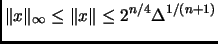 .
.
 , and solve
 for . Recall that we can compute using the Gram matrix,
 det
det .
.
 be the matrix:
![\begin{displaymath}
% latex2html id marker 1751\left[
\begin{array}{ccccc}
\a...
...& 0 \\
& \ddots & \\
0 & & \beta \\
\end{array}\right]
\end{displaymath}](img80.gif)
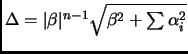 .
.
for the above example.