


Recall that a basis
 for a lattice is Lovász-reduced if it satisfies the relations:
 ,
,
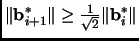 ,
,
 is the Gram-Schmidt orthogonalized sequence
and
is the Gram-Schmidt orthogonalized sequence
and
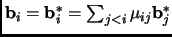 .
In order to prove that Lovász' lattice reduction algorithm
terminates, we introduce the potential function
.
In order to prove that Lovász' lattice reduction algorithm
terminates, we introduce the potential function
 of a basis defined as:
 vol
vol vol
vol vol
vol .
.
We would like to show that the Lovász algorithm terminates
by observing that in each round, the potential function decreases
by a factor bounded above by some constant  .
Because of this, and the fact that
.
Because of this, and the fact that
 is a positive integer,
we know that the algorithm must terminate in a number of rounds
logarithmic in the initial potential.
is a positive integer,
we know that the algorithm must terminate in a number of rounds
logarithmic in the initial potential.

Recall that the ``coefficient reduction'' process
reduces each  to
to
 without affecting the orthogonalized sequence and therefore
without affecting the potential function. Once ``coefficient
reduction'' has been performed,
we check the second property. If there is some
without affecting the orthogonalized sequence and therefore
without affecting the potential function. Once ``coefficient
reduction'' has been performed,
we check the second property. If there is some  with
with
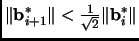 ,
we simply swap these two elements.
This will change the orthogonalized vectors
,
we simply swap these two elements.
This will change the orthogonalized vectors
 and
and
 , but the potential is only affected by:
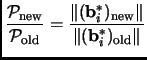
 Span
Span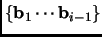 .
After this projection, the vectors
.
After this projection, the vectors
 are taken to the zero vector. Denote the projection by
 . Now examining
 Span
Span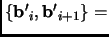 Span
Span , we find that
 |
 |
 |
(1) |
 |
|
 |
(2) |
 |
|
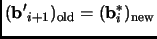 |
(3) |
 |
|
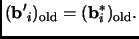 |
(4) |
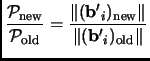
 , the projection of
 onto
is prevented from being very large.
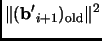
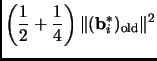
The calculation follows.
onto
is prevented from being very large.
The calculation follows.
 |
|
 |
(5) |
|
 |
(6) | |
 |
 |
(7) | |
|
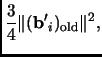 |
(8) |
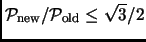 .
.
We see now that we could replace the second Lovász condition by:
 )
)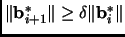 ,
,
 is allowed to be any number such that
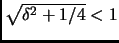 ,
so
,
so
 . The running time and quality of the output would
be expected to be greater for larger values of .
. The running time and quality of the output would
be expected to be greater for larger values of .
for which we know the algorithm
terminates (and specifically in polynomial time).
However, it is possible for the algorithm to terminate for special
inputs and larger values of . (For example, an orthogonal basis
and any would produce an algorithm that terminates.)
 , even though in this case we cannot prove
termination, let alone termination in polynomial time.
Moreover, this large value of produced outputs
of far higher quality than predicted by the analysis.
This is a case in which the search for a polynomial-time algorithm
required an insight into the nature of the problem, and that insight
lead to a solution that turned out to be ``unreasonably effective''
in practice.
, even though in this case we cannot prove
termination, let alone termination in polynomial time.
Moreover, this large value of produced outputs
of far higher quality than predicted by the analysis.
This is a case in which the search for a polynomial-time algorithm
required an insight into the nature of the problem, and that insight
lead to a solution that turned out to be ``unreasonably effective''
in practice.