


The objective of linear programming is to
maximize a linear objective function
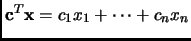 under a
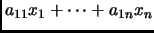
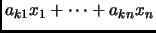
system of constraints of the form
under a
system of constraints of the form
 ,
where
,
where  is some fixed
  matrix, and
 is a fixed
  vector and the meaning of ``
 '' is the
simultaneous system of inequalities in
'' is the
simultaneous system of inequalities in
 :
:
 |
 |
 |
(9) |
 |
 |
(10) | |
 |
|
 |
(11) |
The objective is then to maximize, within this domain, the value of the objective function.
For example,
 could be a profit
function, and the constraints of ,
would be
production constraints.
could be a profit
function, and the constraints of ,
would be
production constraints.
Throughout we will use words
such as ``up'' to denote the direction of
the vector
 . In this terminology,
we need to reach the apex (top vertex) of the polytope
defined by the constraints (if it has vertices).
. In this terminology,
we need to reach the apex (top vertex) of the polytope
defined by the constraints (if it has vertices).
The simplex algorithm (Dantzig, 1950) solves this problem by hopping from vertex to neighboring vertex, always ascending in the polytope. The algorithm terminates when the apex is reached. This algorithm is provably exponential in the worst case, yet in practice is extremely efficient.
This situation presented one of the foremost challenges to the notion of ``polynomial time algorithms.''
The ellipsoid method (Khachiyan, 1979) was the first polynomial-time algorithm for the linear programming problem. Basically the algorithm envelopes the polytope in an ellipsoid, and shrinks the volume of the ellipsoid by a constant factor, at each step making certain to still retain the topmost vertex (though the topmost vertex is unknown). While this algorithm is polynomial time, it is not a practical method for linear programming.
A third method to approach this problem is the interior point method of Karmarkar, which starts from the ``center'' of the polytope; chooses a ball in the interior of the polytope around the starting point, and moving up inside the ball. Then a projective transformation is used to make it appear that the new point is in the center, and we repeat the previous step. (Note: any interior point in a ball can be transformed into the center of the ball without changing the shape of the ball). The result is that the point will approach the apex from inside along a curved trajectory which is a straight line in the hyperbolic space into which the interior of the polytope can be converted.
This, again, is a polynomial time algorithm. In contrast with the ellipsoid method, it is also practical; for very large numbers of variables, the interior point method beats the simplex algorithm on benchmark inputs.