


The objective of primality testing is to take as input a positive integer, and return as output a verdict whether the number is prime or composite. Only as recently as 2002 was it shown that this age-old problem can be solved in polynomial time; the algorithm was discovered by Manindra Agarwal, Neeraj Kayal, and Nitin Saxena (professor and two graduate students) at the Indian Institute of Technology, Kanpur.
Euclid used the sieve of Eratosthenes to perform
primality testing. In this method, one constructs a
list of the integers from  to
to  . From this list,
we remove all of the multiples of 2 on the first step.
Since 3 is the smalles remaining number, it must be
prime. We next remove all multiples of 3. Now
5 is the smallest number remaining, so it is
prime. Remove all its multiples.
. From this list,
we remove all of the multiples of 2 on the first step.
Since 3 is the smalles remaining number, it must be
prime. We next remove all multiples of 3. Now
5 is the smallest number remaining, so it is
prime. Remove all its multiples.
, it is
necessary to continue this process for all primes less
than  (why?). Therefore, if
  is a number
with
is a number
with  digits,
 , then it is necessary to
sieve until
, then it is necessary to
sieve until  - an exponentially long process.
If we know the primes up to , then we need
only
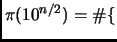 primes
  trial divisions. How much of a savings is this?
To estimate this, we need the celebrated
trial divisions. How much of a savings is this?
To estimate this, we need the celebrated
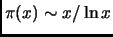 .
.
 .
.
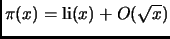
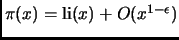 for some constant
 , where
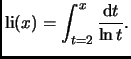
 was conjectured by Gauss.
 is called the logarithmic integral.
 :
:
 .
.
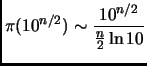 ,
, , is larger than
  .
Thus we still have exponential complexity.
.
Thus we still have exponential complexity.We shall present two randomized (``Monte Carlo'') algorithms. These algorithms have two possible outputs:
In case ``Composite'' is returned, we know that the
number is composite, because a proof of compositeness
is produced. However, in the case the output is ``Prime,''
this is only a guess. It is possible, although
unlikely, that on composite input, the algorithm returns
``prime.'' The probability of this happening is less than
a predetermined
, and it is not
unreasonable to ask  to be less than
 , which error is less than
 number of particles in the
known universe
number of particles in the
known universe .
.
deemed to be prime through
this process is ``very likely prime.'' This statement, however,
does not make sense. is not chosen at random, it is
given explicitly. Therefore either is prime, or it is not,
it cannot have a probability of being prime. Our verdict,
however, is probabilistic; with certain probability we say
`` is prime'' and otherwise we say `` is composite.''
If is prime, we shall always say so, so in this case the
chance that we make an error is zero. If is composite,
then we may accidentally declare that is prime, but
the probability of this happening is  . So overall,
the probability that our verdict is in error is .
. So overall,
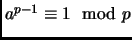
the probability that our verdict is in error is .Our first tool is Fermat's little Theorem.
 is a prime, and
gcd
is a prime, and
gcd , then
 .
.
 is a number
  such that
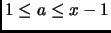 such that
 , or
, or
 and
and
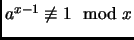 .
.
though we do have a proof that it is composite
using the contrapositve of Fermat's little theorem.Unfortunately, this won't quite work as a basis for a primality test, because of the following:
is a Carmichael number if is odd, not prime,
but for all with
gcd,
 .
.Carmichael numbers are rare, but it has been proved recently that there are infinitely many of them (Alford, Granville, Pomerance, 1994).
 is the product of two primes,
then is not a Carmichael number.
is the product of two primes,
then is not a Carmichael number.
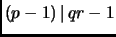
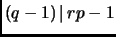
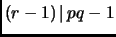
 is a Carmichael number if and only
if
is a Carmichael number if and only
if
 ,
,
 , and
, and
 .
.
 ), 1105 (
 ),
1729 (
),
1729 (
 ), 2465 (
 ),
2821 (
),
2821 (
 ), 6601 (
 ),
8911 (
),
8911 (
 ), 10585 (
 ).
(Note: these are the eight smallest Carmichael numbers.)
).
(Note: these are the eight smallest Carmichael numbers.)



The next exercise shows how to find a witness of compositeness if the input number is not Carmichael.
is composite and not Carmichael,
then the probability that a random is a Fermat witness is at least  .
.