


Let  be a graph with maximal degree
  . Let
. Let  be positive integers such that
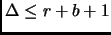 . Does
there exist a coloring of the vertices red and blue
such that
. Does
there exist a coloring of the vertices red and blue
such that
 red neighbors; and
 blue neighbors.
Lovász proved this theorem by showing that the following algorithm always terminates. We call a vertex bad (with respect to the current red/blue coloring) if it violates (i) or (ii).
Procedure ``Lovász toggle''
Start from an arbitrary red/blue coloring of the vertices.
while a bad vertex exists,
pick a bad vertex and recolor it. end (while )

