


We proved in this class that if  is aq prime and
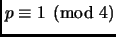 then there exist integers
  such that
 . The goal is to find such
  and
and  in
polynomial time (i.e., in time
in
polynomial time (i.e., in time
 ).
).
Rabin and Shallit showed that we can find in randomized polynomial
time (a Las Vegas algorithm).
As a subroutine, they need to factor polynomials in
 . This
can be done in randomized polynomial time using a Las Vegas algorithm
by Berlekamp.
(Polynomial-time factoring of polynomials over
. This
can be done in randomized polynomial time using a Las Vegas algorithm
by Berlekamp.
(Polynomial-time factoring of polynomials over
 is a consequence of the lattice basis reduction algorithm.
This algorithm does not work for factoring over
and no deterministic polynomial-time algorithm is known
for this case.)
is a consequence of the lattice basis reduction algorithm.
This algorithm does not work for factoring over
and no deterministic polynomial-time algorithm is known
for this case.)
How can we guarantee that a factoring is correct? By multiplying
the factors we can verify that the product equals the input
polynomial. But we also need to test that the factors are
irreducible. Indeed, we
have a deterministic test for irreducibility of polynomials over
.