


 problem
In this section we describe the Rabin-Shallit polynomial-time
Las Vegas algorithm to represent a given prime of the form  as the sum of two squares.
We know that  is a quadratic residue in
 for
for
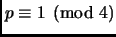 ,
i.e. there exists
,
i.e. there exists  such that
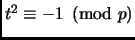 . Our first task
is to find such ? This is equivalent to factoring the polynomial
. Our first task
is to find such ? This is equivalent to factoring the polynomial
![$ x^2+1=(x+t)(x-t)=x^2-t^2 \in F_p[x]$](img69.gif) .
.
![$ {\mathbb{Z}}[i] = \{a+bi ~\colon~ a,b\in {\mathbb{Z}}\}$](img70.gif) .
.Divisibility, primes, g.c.d. are defined among Gaussian integers the same way as among integers. (Recall: by definition, the greatest common divisor is not ``largest'' among the common divisors but one that is a common multiple of all common divisors. So its existence is not evident.)
There are four units (numbers dividing  ) among Gaussian integers,
 , and
, and  .
Let us take a look at Gaussian primes.
.
Let us take a look at Gaussian primes.  and
and  are not primes in
![$ {\mathbb{Z}}[i]$](img76.gif) (because
(because
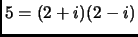 ) but
) but  remains a prime.

![\begin{exercise}
% latex2html id marker 924Prove: if $z,w\in {\mathbb{Z}}[i]$\ and $w\mid z$\ then $N(w)\mid N(z)$.
\end{exercise}](img80.gif)
![\begin{exercise}
% latex2html id marker 927Prove that if $p$\ is a prime numbe...
...nd $p\equiv -1\pmod 4$then $p$\ is a prime in ${\mathbb{Z}}[x]$.
\end{exercise}](img81.gif)

![\begin{exercise}
% latex2html id marker 935Prove that Euclid's algorithm works...
...nation
of $z$\ and $w$\ with coefficients from ${\mathbb{Z}}[i]$.
\end{exercise}](img83.gif)
(unique apart from order and units). (Prove!)The algorithm
Let
. By factoring the polynomial  over
, we found, in Las Vegas polynomial time,
and integer such that
over
, we found, in Las Vegas polynomial time,
and integer such that
 .
Now
.
Now
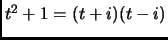 . Since (
 ,
,  unknown)
and
unknown)
and  is a prime in
, it follows that
divides either
is a prime in
, it follows that
divides either  or
or  (but not both - why?).
Therefore splits
(but not both - why?).
Therefore splits  : if
: if
 then
then
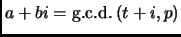 .
Otherwise,
.
Otherwise,
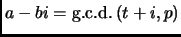 . In either case, we find
  using Euclid's algorithm in
.
using Euclid's algorithm in
.
