


J. Dixon was the first to show that  -digit integers can be factored in
 steps. Let
  be an -digit integer
(
be an -digit integer
(
 ) which we want to factor.
 is a
is a  -smooth integer if all primes dividing
are
-smooth integer if all primes dividing
are  .
.
Suppose we can find  such that
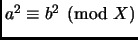 and
and
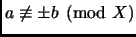 .
Then divides
.
Then divides
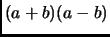 and
and  splits .

How do we find such  and
and  ?
Let be a threshold number
?
Let be a threshold number
 and let
 .
Let
.
Let
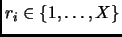 be a random number.
Let
be a random number.
Let
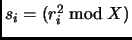 . If
. If  is not
-smooth, discard it and try again. Let
is not
-smooth, discard it and try again. Let  .
Keep generating the
.
Keep generating the  until
until  smooth numbers are found.
Suppose
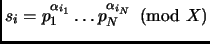 where
where
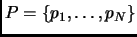 .
.
Consider the matrix
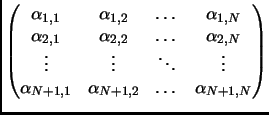
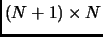 , its rows are linearly dependent
 .
Therefore there exists a nonempty set
.
Therefore there exists a nonempty set
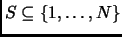 such that
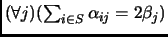 .
Thus
.
Thus
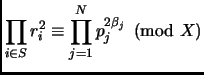
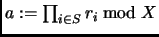 and
and
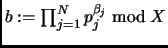 . Now
.
. Now
.
There are two catches in this sketch. First, the smooth numbers
have to happen sufficiently frequently. Second, the probability of
must be significant.
The second claim seems more plausible and can be proven by using a clever counting argument. Here we present intuition behind the first claim.
Let  be the number of -smooth numbers less than .
Let
be the number of -smooth numbers less than .
Let
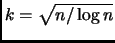 , i.e.
 .
Clearly,
.
Clearly,
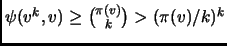 (the product of any
  primes is smooth).
What is the probability that a random number is smooth?
primes is smooth).
What is the probability that a random number is smooth?

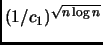 .
Note, however, that the are
not generated uniformly at random, so the actual proof
is necessarily more delicate. But it uses the same simple
lower bound on
.
Note, however, that the are
not generated uniformly at random, so the actual proof
is necessarily more delicate. But it uses the same simple
lower bound on
 .
.