


 to have infinitely many primes, it is necessary that
gcd
to have infinitely many primes, it is necessary that
gcd .
.
, the arithmetic progression,
will have infinitely many primes. is simply the
infinitude of primes.
is simply the
infinitude of primes.
 . Construct
 . Then for any
  ,
,  does not divide
  , so is not divisible by any prime. This is a contradiction, since all numbers
  are divisible by some prime. (This can be easily proved by induction.)

 , and
, and  are congruent mod m, or
 if
if  .
.
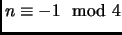 , then it must have a prime divisor
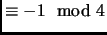 .
. is an odd number. Thus it is the product of odd primes. If all of these primes are
 , then their product is also
, which is a contradiction.
, then their product is also
, which is a contradiction.
. . Construct
. Then by the Lemma,
. Construct
. Then by the Lemma,  must have a prime divisor congruent to
  . However, this is a contradiction, since no divides it (why?).
is not so straightforward.
We need the following
. However, this is a contradiction, since no divides it (why?).
is not so straightforward.
We need the following
 .. Construct
. Then, by the Lemma, all (odd) prime divisors of
.. Construct
. Then, by the Lemma, all (odd) prime divisors of  must be congruent to . This is a contradiction, since this number is not divisible by any of the . (Why did we multiply by 4?)
 is a prime, then
 .
is a prime then
.
is a prime then
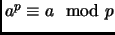 .
is a prime and
.
is a prime and
 , then
 .
is a prime and
, then
.
is a prime and
, then
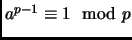 .
.
to ) assume that is positive. Now consider all strings of length of numbers between  and . For example, if
  ,
,  , we could have
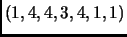 . There are
  such strings. Call two strings equivalent if ``they make the same necklace,'' i.e., they differ by cyclic rotation. That is, the above string is equivalent to
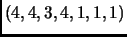 ,
,
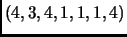 ,
,
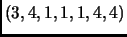 , etc. Now in most cases, there will be exactly equivalent strings. The exceptions are the strings
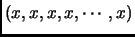 , which will have only one string (themselves) in their equivalence class. Therefore the number of equivalence classes (``necklaces'') is
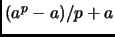 , so
, so  must be an integer.
is a quadratic residue modulo the prime if
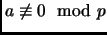 and there exists an
  such that
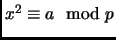 .
.
Proof of Lemma 1.7.
The condition is that
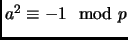 ; and by Fermat's Little Theorem
we have
. Since is odd,
; and by Fermat's Little Theorem
we have
. Since is odd,
 . Now since is odd,
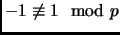 , so
, so  must be even, or
 .
.

 .
.
 .
Hint. Follow the
.
Hint. Follow the  case.
case.
 .
.
is a prime and
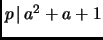 , then
  or
or
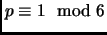 .
Hint. Prove:
.
Hint. Prove:
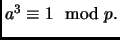
, the order of  is the smallest positive integer
  , such that
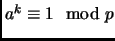 . We say
 ord
ord .
.
is a prime and
, then
ord .
.
is a prime number other than 2 or 5 then the decimal expansion
of  is periodic with period
ord
is periodic with period
ord .
.
is a primitive root modulo if
ord .
.
 , so that all numbers from 1 to 6 appear before repetition occurs in the sequence
 .
.
is a primitive root mod if and only if the set
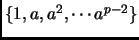 represents all numbers numbers modulo that are not divisible by .
, there exists a primitive root mod .
Our next goal is to prove the following remarkable result:
The ``only if'' part is straightforward:
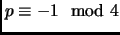 , then cannot be written as the sum of two squares.
Hint. Observe that
, then cannot be written as the sum of two squares.
Hint. Observe that
 or
or  .
.To prove the converse, we need to learn about polynomials, quadratic residues, and lattices.
 is a field. If
  is a polynomial over then
  is a divisor of
  .
.
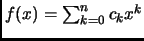 . Since
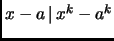 , and
, and
 , we see that
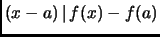 ,
,
![$ F[x]$](img84.gif) is the ring of all polynomials over .
is the ring of all polynomials over .
![$ f\in F[x]$](img85.gif) , and
, and  , then
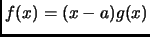 for some
 ![$ g\in F[x]$](img88.gif) .
.
.
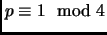
, the following
are equivalent:
 .
.
 is a quadratic residue mod.
 (a) (Lemma 1.7).
For the other direction, assume now that
.
Let
(a) (Lemma 1.7).
For the other direction, assume now that
.
Let
![$ f(x)=x^p-x\in\mathbb{F}_p[x]$](img91.gif) .
By Fermat's Little Theorem, every element of
.
By Fermat's Little Theorem, every element of
 is a root of
  .
We factor as
.
We factor as
 .
Since none of the factors has more roots than its degree and
the total number of roots is , each factor must have exactly as many
roots as its degree. In particular, there must exist a root of
.
Since none of the factors has more roots than its degree and
the total number of roots is , each factor must have exactly as many
roots as its degree. In particular, there must exist a root of
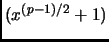 .
However, since
,
.
However, since
,
 . Therefore is a square mod .
 is a set
 , where
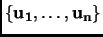 is linearly independent over
 .
.
 is a
fundamental parallelepiped of the lattice
is a
fundamental parallelepiped of the lattice  .
.
Our main interest in this section will be the two-dimensional case,
so instead of the -dimensional parallelepipeds the reader may
think of the familiar parallelograms in the plane.
tile
 , i.e., they cover
without overlapping interiors.
, i.e., they cover
without overlapping interiors.
 corners.
Recall that the area of a parallelogram spanned by
 and
and
 is
is
 . (The analogous determinant expression works in -dimensions.)
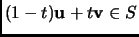
 of a real vector space
  , is called convex if for each
 ,
,  , and each
 ,
,
 in ,
in ,
 .
.
be a lattice in
, and the area of a findamental parallelogram be  . If is convex, centrally symmetric about the origin, and the area of is greater than
  , then
 .
.(The proof of this fundamental result in the ``Geometry of Numbers'' will be given later.) Next we use Minkowski's Theorem to prove Gauss' result, 1.24. The devilishly clever proof is due to Paul Turán.
, then there are integers,  , and , such that
  .
.
 such that
 . Let
. Let
 and
and
 be vectors in
 . A general point in the lattice, spanned by these is
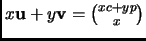 . Note that
 , so if
 is in , then
 . Look at the open disk:
 . The area of is
  , and the area of the fundamental parallelogram is
 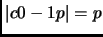 , so by Minkowski's Theorem, 1.37, there is some nonzero point in the lattice and in the disk. Therefore, there exist and such that
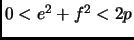 , and
, so
, and
, so
 .
.
Divisor game.
Consider the following game, played by two people: Choose a number . Players take turns naming a factor of . Once a factor is named, it and none of its factors may be named again. The loser is the first player to say .
 ,
,  ,
,  ,
,  .
.
.
Coin placing game.
Given a rectangular table and an unlimited supply of quarters, each player takes turns placing quarters on the table (this is a ``continuous'' game). The quarters, once placed, may not be moved; they may not overlap, and may not hang over the edge.
 , then
 or
or