


Let  be a field. Note that the ring
 ![$ F[x]$](img84.gif) of univariate polynomials over is an infinite-dminesional vector space over with a nice (standard) basis:
of univariate polynomials over is an infinite-dminesional vector space over with a nice (standard) basis:
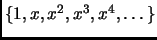 .
.
![$ F_n[x]$](img139.gif) denote the set of polynomials of degree
denote the set of polynomials of degree  .
This is an
.
This is an  -dimensional subspace of . We calculate the
matrix representing the map
-dimensional subspace of . We calculate the
matrix representing the map
![$ \frac{d}{dx}:F_n[x]\to F_n[x]$](img142.gif) with respect
to the standard basis
with respect
to the standard basis
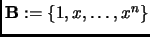 .
.
![\begin{displaymath}
% latex2html id marker 3479\left[\frac{d}{dx}\right]_{{\ma...
...ts & n \\
0 & 0 & 0 & 0 & \ldots & 0 \\
\end{array}\right]
\end{displaymath}](img144.gif)
 by angle
  about the origin.
We denote this linear map by
about the origin.
We denote this linear map by
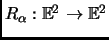 .
Choose as the basis a pair of perpendicular unit vectors
.
Choose as the basis a pair of perpendicular unit vectors
 and
and
 . Then we have that
 , and
, and
 . Therefore the matrix for
  in the basis
 , is
, is
![\begin{displaymath}
% latex2html id marker 3500[R_\alpha]_{{\mathbf{e}},{\math...
...(\alpha)\\
\sin(\alpha)&\cos(\alpha)\\
\end{array}\right].
\end{displaymath}](img154.gif)
 through the line which makes an angle with
horizontal (
) and passes through the origin.
We denote this linear map by
through the line which makes an angle with
horizontal (
) and passes through the origin.
We denote this linear map by
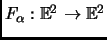 .
Then we have
.
Then we have
 , and
, and
 . Therefore the
matrix for
. Therefore the
matrix for  in the basis
, is
in the basis
, is
![\begin{displaymath}
% latex2html id marker 3519[F_\alpha]_{{\mathbf{e}},{\math...
...lpha)\\
\sin(2\alpha)&-\cos(2\alpha)\\
\end{array}\right].
\end{displaymath}](img160.gif)
 and
and
 , where
is a vector along the line of reflection, and
is perpendicular to it, then the matrix for would be:
, where
is a vector along the line of reflection, and
is perpendicular to it, then the matrix for would be:
![\begin{displaymath}
% latex2html id marker 3532[F_\alpha]_{{\mathbf{u}},{\math...
...
\begin{array}{rr}
1 & 0 \\
0 & -1 \\
\end{array}\right].
\end{displaymath}](img161.gif)
 , define
 , the trace of
to be the sum of the diagonal entries of .
, the trace of
to be the sum of the diagonal entries of .
![% latex2html id marker 3544
$ \mathop{\rm tr}\nolimits ([F_\alpha]_{{\mathbf{e}}...
...athbf{f}}})=0=\mathop{\rm tr}\nolimits ([F_\alpha]_{{\mathbf{u}},{\mathbf{v}}})$](img163.gif) .
.
![$ \det([F_\alpha]_{{\mathbf{e}},{\mathbf{f}}})=-1=\det([F_\alpha]_{{\mathbf{u}},{\mathbf{v}}})$](img164.gif) .
.
 , and
, and
 be two bases for a vector space
  . The basis change transformation
  is the unique (invertible) linear map defined by
 .
.
 be a vector in . Then
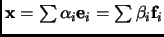 . Notice that
 .
.
![\begin{displaymath}
% latex2html id marker 3569[{\mathbf{x}}]_{{\mathbf{e}}}=
...
...rray}{c}
\alpha_1 \\
\vdots \\
\alpha_n
\end{array}\right]
\end{displaymath}](img173.gif)
![$ [S{\mathbf{x}}]_{{\mathbf{f}}}=[{\mathbf{x}}]_{\mathbf{e}}$](img174.gif) . Also,
. Also,
![$ [S{\mathbf{x}}]_{{\mathbf{f}}}=[S]_{{\mathbf{f}}}[{\mathbf{x}}]_{{\mathbf{f}}}$](img175.gif) by the following exercise. Thus
by the following exercise. Thus
![$ [{\mathbf{x}}]_{{\mathbf{f}}}=[S^{-1}]_{{\mathbf{f}}}[{\mathbf{x}}]_{{\mathbf{e}}}$](img176.gif)
be a basis for , and let
be a basis for  . Let
. Let
 , and let
  . Show that
![$ [A]_{{\mathbf{e}},{\mathbf{f}}}[{\mathbf{v}}]_{\mathbf{e}}=[A{\mathbf{v}}]_{{\mathbf{f}}}$](img180.gif) .
.
 be vector spaces over .
Let
be a basis for ,
be a basis for ,
be vector spaces over .
Let
be a basis for ,
be a basis for ,
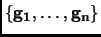 be a basis for
  . Let ,
  .
Show that
.
Show that
![$ [BA]_{{\mathbf{e}},{\mathbf{g}}}=[B]_{{\mathbf{f}},{\mathbf{g}}}[A]_{{\mathbf{e}},{\mathbf{f}}}$](img185.gif) .
.
 ,
,  are
are  matrices that
 for all
 then
then  .
.
,
 be two bases for with change of basis map
 .
Let
,
.
Let
,
 be two bases for with change of basis map
 .
Let . We want to compare
.
Let . We want to compare
![$ [A]_{{\mathbf{e}}{\mathbf{f}}}$](img196.gif) with
with
![$ [A]_{{\mathbf{e'}}{\mathbf{f'}}}$](img197.gif) .
Let
.
Let
 . We have the following identities:
![$ [A{\mathbf{x}}]_{{\mathbf{f}}}=[A]_{{\mathbf{e}}{\mathbf{f}}}[{\mathbf{x}}]_{{\mathbf{e}}}$](img199.gif)
![$ [A{\mathbf{x}}]_{{\mathbf{f'}}}=[A]_{{\mathbf{e'}}{\mathbf{f'}}}[{\mathbf{x}}]...
...\mathbf{f'}}}[S^{-1}]_{{\mathbf{e'}}{\mathbf{e'}}}[{\mathbf{x}}]_{{\mathbf{e}}}$](img200.gif)
![$ [A{\mathbf{x}}]_{{\mathbf{f'}}}=[T^{-1}]_{{\mathbf{f'}}{\mathbf{f'}}}[A{\mathbf{x}}]_{{\mathbf{f}}}$](img201.gif) .
,
.
,
![$\displaystyle ([T^{-1}]_{{\mathbf{f'}}{\mathbf{f'}}}[A]_{{\mathbf{e}}{\mathbf{f...
...thbf{f'}}}[S^{-1}]_{{\mathbf{e'}}{\mathbf{e'}}})[{\mathbf{x}}]_{{\mathbf{e}}}.
$](img202.gif)
![$\displaystyle [T^{-1}]_{{\mathbf{f'}}{\mathbf{f'}}}[A]_{{\mathbf{e}}{\mathbf{f}}}=[A]_{{\mathbf{e'}}{\mathbf{f'}}}[S^{-1}]_{{\mathbf{e'}}{\mathbf{e'}}}.
$](img203.gif)
![$\displaystyle [A]_{{\mathbf{e}}{\mathbf{f}}}=[T]_{{\mathbf{f'}}{\mathbf{f'}}}[A...
...f{f'}}}[S^{-1}]_{{\mathbf{e'}}{\mathbf{e'}}}=[TAS]_{{\mathbf{e'}}{\mathbf{f'}}}$](img204.gif) .
.
 . Then
![$\displaystyle [S]_{{\mathbf{e}}{\mathbf{e}}}=[TAS^{-1}]_{{\mathbf{f}}{\mathbf{f}}}=[S]_{{\mathbf{f}}{\mathbf{f}}}$](img206.gif) .
.
 ,
,  , then

 matrices , are similar if there exists some invertible
  such that
 . We write
  .
.
 of a matrix is the determinant
 det
det , where
  is the identity matrix.
and are matrices, then
det det
det det
det .
.
then
det det.
det.
then  .
.
is a matrix, the roots of are called the eigenvalues of .
 is a linear transformation, then the characteristic polynomial of is the characteristic polynomial of a matrix for in some basis. The last exercise shows that this is well-defined.
is a linear transformation, then the eigenvalues of are the roots of the characteristic polynomial.
is an upper triangular matrix, then the eigenvalues of are the diagonal entries of , taken with multiplicity.
 matrices, and such that but and are not similar.
is an matrix over a field , and has  distinct roots in , then is ``diagonalizable,'' i.e., is similar to a diagonal matrix. (What are the entries of this diagonal matrix?)