


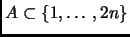
 with
with  , show two elements of
  are relatively prime.
divides another.
Hint. Pigeon hole principle.
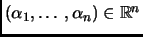 and
and
 there exist
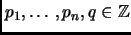 such that
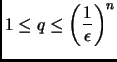 and
and 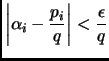 for all
The proof is a striking application of the Pigeon Hole Principle.
 for
for  , with
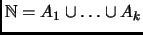 and
and
 .
Show it is not possible for all the increments to be distinct. (In fact the largest increment must occur at least twice).
.
Show it is not possible for all the increments to be distinct. (In fact the largest increment must occur at least twice).