


![% latex2html id marker 1851
$\displaystyle A=
\left[ \begin{array}{cc}
1 & 1 \\
0 & 1 \\
\end{array}\right]$](img14.gif) and
and ![% latex2html id marker 1852
$\displaystyle B=
\left[\begin{array}{cc}
1 & 0 \\
0 & 1 \\
\end{array}\right]$](img15.gif) and the characteristic polynomials are
and the characteristic polynomials are 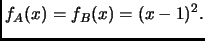
 is an eigenvector to the geometric eigenvalue
  for matrix
  if
if
 and
and
 .
An algebraic eigenvalue of is a root of the characteristic polynomial
.
An algebraic eigenvalue of is a root of the characteristic polynomial  .
.
 is an inhomogeneous system of equations. Show it has a solution iff
 span
span
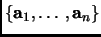 iff rk
  rk
rk
 .
.
 is a homogeneous system of equations. Show it has a nontrivial solution iff columns are linearly dependent.
Determinants - quick and dirty1.
Given an  matrix , let
  denote the matrix formed by deleting the
  row and
  column. The determinat-expansion by the
  -th column is
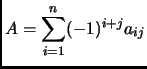 det
det - the choice of
  doesn't matter,
![% latex2html id marker 1903
$\displaystyle \left[\begin{array}{cc}
a & b\\
c & d
\end{array}\right]
=ad-bc.
$](img37.gif)
We could also reverse the roles of  and in the above equation.
Switching two rows or two columns changes the sign of the determinant.
Adding some linear combination of rows (or columns)
to another row (or column respectively) does not affect the determinant.
and in the above equation.
Switching two rows or two columns changes the sign of the determinant.
Adding some linear combination of rows (or columns)
to another row (or column respectively) does not affect the determinant.
Note that the above rules are rules of calculation, not definition. It is far from obvious that these rules actually result in a unique number regardless of the choices made along the way. (What is the definition?)
 iff the columns are linearly dependent.
is an eigenvalue of iff
 . (In other words the two definitions of eigenvalue are equivalent).
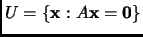 . This is a subspace of
  .
Show dim
.
Show dim  rk , where by rk we mean the row rank.
is dim
 .
.
![% latex2html id marker 1937
$\displaystyle \left[ \begin{array}{cc}
1 & 1 \\
0 & 1 \\
\end{array}\right]$](img45.gif) has eigenvalue 1 with algebraic multiplicity 2 and geometric multiplicity 1
has eigenvalue 1 with algebraic multiplicity 2 and geometric multiplicity 1
![% latex2html id marker 1941
$\displaystyle R_\alpha=\left[\begin{array}{cc}
\cos\alpha & -\sin\alpha\\
\sin\alpha & \cos\alpha
\end{array}\right]$](img47.gif) is a matrix with no eigenvalues over
is a matrix with no eigenvalues over 
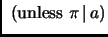
 then
then  has eigenvectors
![% latex2html id marker 1950
$\displaystyle \left[\begin{array}{c}
i\\
1
\end{array}\right]$](img52.gif) and
and ![% latex2html id marker 1951
$\displaystyle \left[\begin{array}{c}
-i\\
1
\end{array}\right]$](img53.gif) and eigenvalues
and eigenvalues 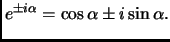
a matrix is diagonalizable (i.e., it has an eigenbasis) iff the geometric and algebraic multiplicities of all its eigenvalues coincide.