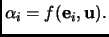
Let
 denote
 or
or
 .
.
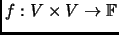 is a Hermitian form if
 ,
,
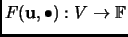 is linear
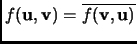 .
.
 . A matrix
  is Hermitian if
  =.
Given such a matrix, then
=.
Given such a matrix, then
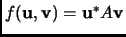 is a Hermitian form.
.
 . (Why is this always real?) This is a quadratic form.
 is positive semidefinite if for all
,
is positive semidefinite if for all
,
 .
is positive definite if for all
.
is positive definite if for all
 ,
,
 .
.
 consisting of a vector space
  (over
or
) and a positive definite Hermitian form
(over
or
) and a positive definite Hermitian form  .
.
 with the usual dot product
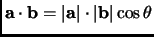 , where
  is the angle between
 and
and
 is an example; this is the same as
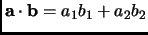 .
.
is perpendicular to
 , denoted by
 , if
, if
 .
We define the norm of
by
.
We define the norm of
by
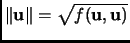 .
.
 such that
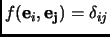 .
.
Expressing a vector in coordinates involves solving an inhomogeneous system of equations. However if we wish to express
in orthonormal coordinates
 , we calculate