


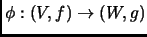
 such that
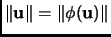 for all
 . Show
  is an isometry iff
 for all vectors
 and
and
 in
in  .
.
is an isometry iff it maps an orthonormal basis to an orthonormal basis.
![$ f({\mathbf{u}},{\mathbf{v}})=[{\mathbf{u}}]^*_{\underline{e}}[{\mathbf{v}}]_{\underline{e}}=\overline{u}_1v_1+\cdots+\overline{u}_nv_n$](img93.gif) where
where
 is an orthonormal basis.
 is an isometry iff the columns of
  form an orthonormal basis of
 , where
  is the dimension of .
is an isometry iff  iff
iff
 iff
iff  . Such a matrix is called unitary.
 .
.When are diagonal matrices unitary?
If and only if iff
 for all
  iff all eigenvalues have unit length.
and  are similar under unitary transforms, denoted
  , if there exists a unitary matrix
  such that
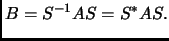
 if and only if is similar under unitary transforms to
![\begin{displaymath}
% latex2html id marker 2123\left[
\begin{array}{ccc}
\lamb...
...{array}\right]\mbox{ with the } \lambda_i\mbox{ real numbers.}
\end{displaymath}](img107.gif)