


 ,
,
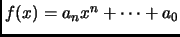 , and a rational root
  with
gcd
with
gcd , then
 , and
, and
 .
.
 is an
is an  matrix, and
  is a
is a  matrix, then
Tr
matrix, then
Tr Tr
Tr .
.
and are  matrices, and
  , then
Tr
, then
Tr Tr
Tr .
.
 Tr
Tr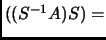 Tr
Tr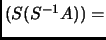 Tr
Tr

We may also prove this by considering the characteristic polynomial of .
Let
 .
Then
.
Then
 Tr
Tr ,
,
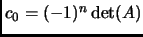 , and generally:
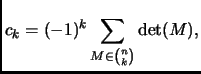
 symmetric minors
of . A symmetric minor is a submatrix symmetrically
positioned with respect to the main diagonal, i.e.,
it has the same row numbers and column numbers. Since
the characteristic polynomial is preserved under
similarity, all such expressions are preserved, so
specifically, the traces of similar matrices are equal.
symmetric minors
of . A symmetric minor is a submatrix symmetrically
positioned with respect to the main diagonal, i.e.,
it has the same row numbers and column numbers. Since
the characteristic polynomial is preserved under
similarity, all such expressions are preserved, so
specifically, the traces of similar matrices are equal.

 is similar
to an upper triangular matrix, and the diagonal
entries of an upper triangular matrix are its
eigenvalues. This gives an alternative proof of the fact
that the trace of a square matrix is
the sum of its eigenvalues.
is similar
to an upper triangular matrix, and the diagonal
entries of an upper triangular matrix are its
eigenvalues. This gives an alternative proof of the fact
that the trace of a square matrix is
the sum of its eigenvalues.