


 is called a 2-distance set
if there exist
is called a 2-distance set
if there exist
 such that
 .
.

 :
:
 : standard orthonormal basis (vectors
 ),
),
 : hyper-octahedron (vectors
 ),
),
 : vectors
 for
for  .
.

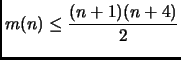
The following theorem shows that this example is asymptotically optimal.
 be the maximum size of a 2-distance set in
.
Then
be the maximum size of a 2-distance set in
.
Then
The proof of this theorem is an application of the
``linear algebra method:'' associate  vectors from
some space
vectors from
some space  with our objects in such a way that the
constraints on our objects imply that the vectors
associated will be linearly independent. Then it
will follow that
with our objects in such a way that the
constraints on our objects imply that the vectors
associated will be linearly independent. Then it
will follow that
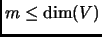 . Choose such that
 will be the desired bound (in this case,
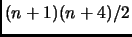 ).
).
The trick, of course, is to find the right space and
the way of matching our objects to vectors in so
that the constraints translate into linear independence.
Our space will be a space of multivariate polynomials;
the trick goes back to a paper by Koornwinder.
A complete proof can be found in the ``blue book'' by Babai and Frankl, page 13.