


Instructor: Laszlo Babai
Scribe: Varsha Dani

We now turn our attention to an algorithmic problem. Consider a lattice in
 , specified by a basis. We want to find the shortest non-zero vector
in the lattice. Moreover, we would like to be able to do this ``efficiently,''
in the sense that the number of steps taken by the algorithm should
be bounded by a polynomial function of the bit-length of the input
(number of zeros and ones needed to describe the input).
, specified by a basis. We want to find the shortest non-zero vector
in the lattice. Moreover, we would like to be able to do this ``efficiently,''
in the sense that the number of steps taken by the algorithm should
be bounded by a polynomial function of the bit-length of the input
(number of zeros and ones needed to describe the input).
Let
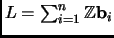 where the
 are linearly
independent. Note that we restrict our attention to bases in
are linearly
independent. Note that we restrict our attention to bases in
 rather
than
because we need the number of bits in the input to be finite.
The length is the total number of bits needed to describe all entries of the
matrix
rather
than
because we need the number of bits in the input to be finite.
The length is the total number of bits needed to describe all entries of the
matrix
![$ [b_1, b_2, \dots, b_n]$](img9.gif) .
.

So for example if each coordinate has  bits, then the input length is
 .
.
A polynomial time algorithm is one that takes at most
 input length
 steps to execute. For example an algorithm
that runs in
steps to execute. For example an algorithm
that runs in
 input length
 steps is a cubic algorithm.
The shortest vector in a lattice is the zero vector. When we talk about ``the shortest vector'' in a lattice, we mean the shortest non-zero vector.
Finding the shortest vector in a lattice is NP-hard (Ajtai, 2000). Roughly speaking this means that the problem is at least as hard as any combinatorial search problem: if we could solve it in polynomial time, we could use that to solve any other combinatorial search problem in polynomial time. For example we could factor large numbers in polynomial time.
Lovász's lattice reduction algorithm (1980)
which we are about to see is a polynomial time
algorithm, and it does not find the shortest vector in the lattice.
What it does find is a vector in the lattice that is ``short enough.''
Specifically, it finds a vector  with
with
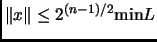 where
where  is the dimension and

 -approximation to the shortest vector in the lattice.
First we need to define a Lovász-reduced basis. Recall the Gram-Schmidt
orthogonalization process for obtaining an
orthogonal basis for the span of a set of
linearly independent vectors. If
 is the original basis, and
 is the orthogonalized basis then we have
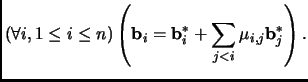 is orthogonal then
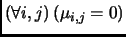 .
One possible meaning of being ``close to orthogonal'' is
that all the
.
One possible meaning of being ``close to orthogonal'' is
that all the  are small in absolute value;
a Lovász-reduced basis intends to meet this objective.
are small in absolute value;
a Lovász-reduced basis intends to meet this objective.
Additionally, we do not want the basis vector
 to be too close
to the subspace
to be too close
to the subspace
 , the span of
 ,
i.e., we do not want
,
i.e., we do not want
 to have too small norm.
The following definition gives a prcise meaning to these two requirements:
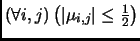
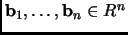 is Lovász-reduced
if after performing the Gram-Schmidt orthogonalization process on it,
the following conditions hold:
is Lovász-reduced
if after performing the Gram-Schmidt orthogonalization process on it,
the following conditions hold:
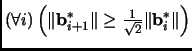
Note that the definition is sensitive to order: the same basis vectors in a different order may not form a Lovász-reduced basis.
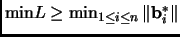
The following lemma applies to all bases, not only to
L-reduced ones. The lemma will be our key tool to
proving that in a L-reduced basis, the first basis vector is
not much longer than
 .
.
 .
.
 ,
,
 .
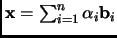
Then there exist
.
Then there exist
 not all zero,
such that
not all zero,
such that
 .
Let
.
Let  be the largest index for which
 , i.e.,
and
, i.e.,
and
 for all
  .
Then
.
Then
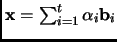 . Now recall that the Gram-Schmidt
process on
produces orthogonal vectors
with
the property that for all
. Now recall that the Gram-Schmidt
process on
produces orthogonal vectors
with
the property that for all  with
with
 ,
,
 . Thus there exist
 such that
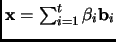 .
Note that while the
.
Note that while the  do not have to be
integers, the last one,
do not have to be
integers, the last one,  is an integer.
To see this, note that for all with
is an integer.
To see this, note that for all with
 ,
,
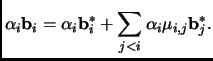
 , we obtain
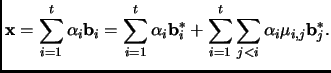
 , so
occurs
only once, with coefficient
, so
occurs
only once, with coefficient  .
Since the
are linearly independent
and
.
Since the
are linearly independent
and
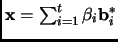 it follows that
 .
Now since the
are orthogonal,
.
Now since the
are orthogonal,

 and
and
 then
then
 .
Taking the minimum over all
now completes the proof.
.
Taking the minimum over all
now completes the proof.

is a Lovász-reduced basis for the lattice  then for all ,
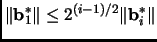 (by induction, using property (2) of such a basis). Therefore

Since
 we have
is a Lovász-reduced basis for lattice then
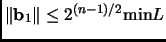 .
.
We still have to find a Lovász-reduced basis in .
Lovász's Algorithm
Input:
![$ [{\mathbf{b}}_1, \dots , {\mathbf{b}}_n] \in {\mathbb{Z}}^{n \times n}$](img70.gif) , non-singular.
, non-singular.
Output:
![$ [{\mathbf{b}}_1', \dots , {\mathbf{b}}_n'] \in {\mathbb{Z}}^{n \times n}$](img71.gif) ,
a Lovász-reduced basis of the same lattice, i.e.,
,
a Lovász-reduced basis of the same lattice, i.e.,
 .
.
The algorithm will make two kinds of steps, which try to achieve the
two conditions in the definitions. The first kind will perform
elementary transformations on the basis (replacing
by
 for a suitable scalar
 ) with the goal to make the condition
 hold. We repeat this type of steps until all satisfy
this inequality (so condition (1) holds).
hold. We repeat this type of steps until all satisfy
this inequality (so condition (1) holds).
Once condition (1) has been achieved, we
check for condition (2) and will switch the order of
a pair of consecutive basis vectors where violation is found.
We perform this operation only once per round.
While it is not immediately clear how this kind of rearrangement
is of any help, it is clear that such a rearrangement
may destroy the condition
we have labored hard to achieve, so we must return to
the elementary transformations to restore condition (1).
All in all, it is not evident that such an approach will converge to anything at all; but if it does converge, the result is a Lovász-reduced basis.
Making the
 s small
Let
 denote
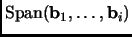 .
If
.
If
 are the vectors
produced by the Gram-Schmidt process, then for all
,
are the vectors
produced by the Gram-Schmidt process, then for all
,
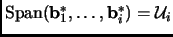 and
and
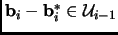 ; and these two
conditions determine the
. So the
elementary transformations
; and these two
conditions determine the
. So the
elementary transformations
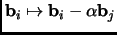
 do not change any of the
.
do not change any of the
.
 will produce the same vectors
.
On the other hand, the will change; we need to
calculate this change to see that with the appropriate choice
of the coefficient
will produce the same vectors
.
On the other hand, the will change; we need to
calculate this change to see that with the appropriate choice
of the coefficient
 , the condition
 will be achieved.
Here is then the first procedure:
Procedure ``coefficient reduction''
for  to
to
for  downto
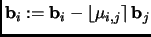
Here
 denotes the integer nearest to
  .
Ties are broken arbitrarily.
.
Ties are broken arbitrarily.


Complexity analysis: ``coefficient reduction''
requires
 elementary
basis transformations, each of which takes
elementary
basis transformations, each of which takes  arithmetic operations.
One more thing to worry about: do the integers involved grow in the
process?
arithmetic operations.
One more thing to worry about: do the integers involved grow in the
process?

Swapping
Now we check property 2. If it is violated, we swap
a violating pair
and
 . Then we start over with
coefficient reduction again. If property 2 is ever
satisfied after coefficient reduction then we are done.
Here is the full algorithm in pseudocode:
. Then we start over with
coefficient reduction again. If property 2 is ever
satisfied after coefficient reduction then we are done.
Here is the full algorithm in pseudocode:
Procedure ``Lattice Reduction''
while basis not Lovász-reduced
if
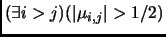 then do coefficient reduction
else find first such that
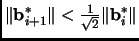 ;
;
swap
and
;
update orthogonalized sequence.
To prove that this algorithm terminates, we use a potential function argument, a general method of algorithm analysis which assigns a value (the ``potential'') to each ``configuration'' of variables in such a way that each phase of the algorithm reduces the potantial.
The Lovász potential of a basis
is defined to be the quantity

 refers to the appropriate dimensional volume
of the parallelepiped spanned by the vectors in the argument.
refers to the appropriate dimensional volume
of the parallelepiped spanned by the vectors in the argument.

It follows from the exercise that the Lovász potential does not change under the ``coefficient reduction'' procedure. (Why?)


Therefore, for integral lattices,
the Lovász potential is  It follows that
the algorithm terminates in
It follows that
the algorithm terminates in
 phases, where
  is the
initial potential. Since each phase takes
is the
initial potential. Since each phase takes  steps, the algorithm takes
 steps.


 ;
;
 .
.