


Instructor: Laszlo Babai
Scribe: David Balduzzi
READING: Please read the handout on irreducibility of polynomials (last chapter of ``Algebra review'' handout.)
Recall that  is an algebraic number if is a root
of some nonzero polynomial
is an algebraic number if is a root
of some nonzero polynomial  with rational coefficients. If
has the lowest possible degree then we call minimal polynomial
of . The degree of is the degree of its
minimal polynomial.
with rational coefficients. If
has the lowest possible degree then we call minimal polynomial
of . The degree of is the degree of its
minimal polynomial.
 .
.
![$ f\in\mathbb{\mathbb C}[x]$](img4.gif) with
with
 . Then is a multiple root
of if and only if
. Then is a multiple root
of if and only if
 .
.

The following straightforward observation is used to great effect in many arguments about diophantine approximation and algorithm analysis.
 and
and  then
then  .
.
be an algebraic number of degree  . Then
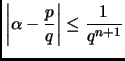


![$ f\in{\mathbb{Z}}[x]$](img15.gif) ,
,  ,
and
is a simple roort of . Therefore can be
written as
,
and
is a simple roort of . Therefore can be
written as
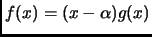 , where
![$ g\in {\mathbb{C}}[x]$](img18.gif) and
and
 .
Now
.
Now
 |
(1) |
(Why does
 ?) So
?) So
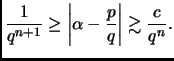
 is bounded and therefore
there are only a finite number of solutions.
is bounded and therefore
there are only a finite number of solutions.
 and
and
 in the plane, avoiding certain straight line segments (``obstacles'').
The obstacles are perpendicular to
in the plane, avoiding certain straight line segments (``obstacles'').
The obstacles are perpendicular to
 drawn such that they have ``convex boundary.''
Can the number of candidate optimum paths be bounded by  , where
 is the number of obstacles? In other words can an algorithm be
found limiting the number of candidate paths to a polynomial number.
is the number of obstacles? In other words can an algorithm be
found limiting the number of candidate paths to a polynomial number.
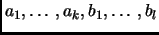 can we decide
in polynomial time (in terms of total bit length) if
can we decide
in polynomial time (in terms of total bit length) if
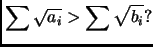
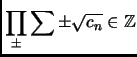
 always positive.
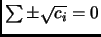 . Then
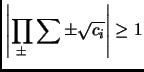 implies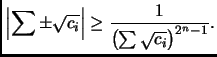
 of sequences such that
  is a collection
of -digit numbers; with the additional property that for some
choice of signs,
is a collection
of -digit numbers; with the additional property that for some
choice of signs,
 log
log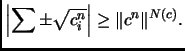
 log
log
 grow faster than
 ?
?Review seventh problem set.
 .
.
 . Show
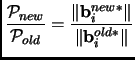
 and
and
 .)
.)