


 is product-free if
it contains no solutions to
is product-free if
it contains no solutions to  . It is triangle-free if
it contains no solution to
. It is triangle-free if
it contains no solution to  , with
  not all the same.
Let
not all the same.
Let  be the size of the largest triangle-free subset of
  .
Let
.
Let
 .
.
We showed that for abelian groups we could find a product-free subset
of size
 . We cannot achieve such a constant fraction
in a triangle-free subset. That is, there exists a sequence of groups
such that
. We cannot achieve such a constant fraction
in a triangle-free subset. That is, there exists a sequence of groups
such that
 , but the instructor can only show
that it goes to 0 very slowly.
, but the instructor can only show
that it goes to 0 very slowly.
The sequence of groups
 model higher-dimensional versions
of the Set game.
model higher-dimensional versions
of the Set game.
 is the number of cards that can contain
no Set.
is the number of cards that can contain
no Set.
![\begin{exercise}
% latex2html id marker 902
$L=\lim\sqrt[k]{\alpha(G_k)}$\ exists. $2\le L\le 3$.
\end{exercise}](img144.gif)
![\begin{exercise}
% latex2html id marker 904$L\ge\sqrt[4]{20}$. \ {\em Hint.} Find 20 Set cards without a Set.
\end{exercise}](img145.gif)
 .
.
 and
and  , if we color the natural numbers with colors,
we can find a monochromatic arithmetic progression of terms.
, if we color the natural numbers with colors,
we can find a monochromatic arithmetic progression of terms.

 , there exists
  such that for any
![$ S\subset[N]$](img151.gif) with
with
 ,
,  contains a -term arithmetic progression.
This theorem, conjectured by Erdos-Turán and sometimes called the ``density version of van der Waerden's theorem'' was proved by Szemerédi using a Ramsey-type theorem for graphs (The Szemerédi Lemma). A noteworthy later proof due to Furstenberg uses a fixed-point theorem and ergodic theory.
 elements
 of
of ![$ [t]^N$](img155.gif) is a combinatorial line if for each of the coordinates,
the elements all have the same value
is a combinatorial line if for each of the coordinates,
the elements all have the same value
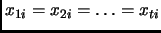 or
or  for all
  .
.
and , there exists sucht if
we color by colors, there exists a monochromatic combinatorial
line.
This is called the ``combinatorial essence'' of van der Waerden's
theorem.
Also, there are two more parameters: it should be that we color the
 -dimensional spaces and fine a
  -dimensional space, all of whose
-dimensional subspaces are the same color.
-dimensional space, all of whose
-dimensional subspaces are the same color.


