


 is connected if every pair of vertices is
connected by a path. It is
is connected if every pair of vertices is
connected by a path. It is  -connected if it remains
connected after removing any
-connected if it remains
connected after removing any  vertices (except the complete graph
  which is
  -connected by convention).
Let
-connected by convention).
Let  be the maximum such that
  is -connected.
is called the vertex-connectivity of .
is -connected.
is called the vertex-connectivity of .
 for all
  . One should think
of this as a topological invariant and all cycles have the same shape.
This requires the convention that
. One should think
of this as a topological invariant and all cycles have the same shape.
This requires the convention that
 .
.
 are vertices in a graph , then the
  -
- -connectivity
 is the minimum number of vertices to delete to prevent
there from being a path from to . (If there's a direct edge from
to , count deleting it as deleting a vertex.)
Then
is the minimum number of vertices to delete to prevent
there from being a path from to . (If there's a direct edge from
to , count deleting it as deleting a vertex.)
Then
 . There is a similar notion
 for directed graphs and directed paths from to .
There is also the edge --connectivity
for directed graphs and directed paths from to .
There is also the edge --connectivity
 , the
minimum number of edges to delete to prevent there from being a path
from to . This has a global version
, the
minimum number of edges to delete to prevent there from being a path
from to . This has a global version
 and a directed version
  .
.
is also the number of
vertex-disjoint paths from to .
is also the number
of edge-disjoint paths from to . The analogous directed versions
are also true.


is a vertex-transitive graph if its
automorphism group acts transitively on its vertices. Similarly, it
is edge-transitive if the automorphism group acts transitively
on the edges. It is vertex- or edge-primitive if the
automorphism group acts primitively on the set of vertices (edges,
respectively).


is an undirected, connected,
vertex-transitive graph, regular of degree  , then
 ;
;
 ;
is edge-transitive or vertex-primitive, then
;
is edge-transitive or vertex-primitive, then
 .
.

and , there is a directed path from to . It is weakly
connected if it is a connected as an undirected graph
when we ignore the orientation of the edges.
satisfies the Euler condition if
for each vertex the in-degree is equal to the out-degree.


a finite, connected vertex-transitive
digraph then
 ;
;
 ;
is edge-transitive or vertex-primitive, then
;
is edge-transitive or vertex-primitive, then
 .
.

A typesetting command error (a signle omitted backslash) rendered a paragraph unintelligible in the previous handout. It was the paragraph connecting two theorems. Here we reproduce the two theorems with the corrected paragraph inbetween.
 generate
  .
.
 .
.This result suffers from the ``element-order bottleneck.'' The two tricks used are commutators and raising elements to powers. A recent result gives a polynomial upper bound under the condition that one of the generators fixes 70% of the permutation domain. So now all is left to prove is that we can reach such a permutation in a polynomially bounded number of steps. Somebody in this audience may be able to do this with a fresh idea.
generate .
If
 with the
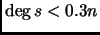 then
then
 (
( ?). (Recall that the degree of a permutation is
size of its support, the set of
elements that it actually moves.)
?). (Recall that the degree of a permutation is
size of its support, the set of
elements that it actually moves.)