


![$ [k]=\{1,2,\ldots,k\}$](img1.gif) ;
;
![$ [k]^n=\{(x_1,\ldots,x_n) : x_i\in[k]\}$](img2.gif) .
.
![$ L\subseteq [k]^n$](img3.gif) with
with  elements is called a
combinatorial line if we can arrange the elements in
an order so that in every coordinate either all the entries
are the same or they form the sequence
elements is called a
combinatorial line if we can arrange the elements in
an order so that in every coordinate either all the entries
are the same or they form the sequence
 , in that order.
Note: A combinatorial line is a ``SET" in the game ``SET." The converse is not true. (why?)
 there exists an
  such that for all
  and
any -coloring of
and
any -coloring of ![$ [\ell]^n$](img9.gif) , there exists a combinatorial line in one color.
, there exists a combinatorial line in one color.Note: This theorem implies Van der Waerden's theorem:
there exists  such that for all
  ,
if we color
,
if we color ![$ [N]$](img12.gif) with colors, then there is an
with colors, then there is an  -term
arithmetic progression in one color.
-term
arithmetic progression in one color.
The idea is to let
 , and to associate with every number
in the digits in its expansion in the base- number system.
Then any combinatorial line would correspond to an arithmetic progression.
(But not conversely. Why?)
, and to associate with every number
in the digits in its expansion in the base- number system.
Then any combinatorial line would correspond to an arithmetic progression.
(But not conversely. Why?)
Recall Szemerédi's Theorem, which is the ``density version'' of van der Waerden's Theorem:
 and there exists such that for all
 , if
, if
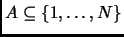 and
and
 then
then  contains an -term arithmetic progression.
The density version of the Hales-Jewett Theorem is:
and all there exists such that for
all  , if
, if
![$ A\subseteq [\ell]^n$](img21.gif) and
and
 ,
then contains a combinatorial line.
,
then contains a combinatorial line.
