


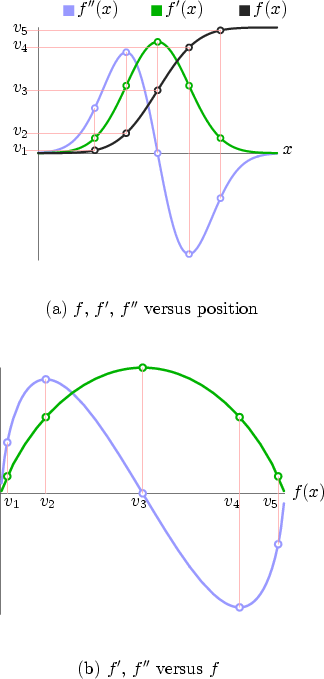
 through
  , have been indicated on the vertical axis.
The pattern of horizontal and vertical lines shows that for each of
these five data values, we have an associated first and second
derivative values. This association is formed through the
relationship between data value and position which is governed by the
graph of
, have been indicated on the vertical axis.
The pattern of horizontal and vertical lines shows that for each of
these five data values, we have an associated first and second
derivative values. This association is formed through the
relationship between data value and position which is governed by the
graph of  . If we were to plot the derivatives associated with data
value as we moved through the range of data values, we would get the
curves seen in Figure 3.5(b). Data value, not position,
is on the horizontal axis, on which through are shown.
The crucial change is that information about position has been
entirely removed from the picture, and we are left with the
relationship between the data value and its derivatives.
. If we were to plot the derivatives associated with data
value as we moved through the range of data values, we would get the
curves seen in Figure 3.5(b). Data value, not position,
is on the horizontal axis, on which through are shown.
The crucial change is that information about position has been
entirely removed from the picture, and we are left with the
relationship between the data value and its derivatives.
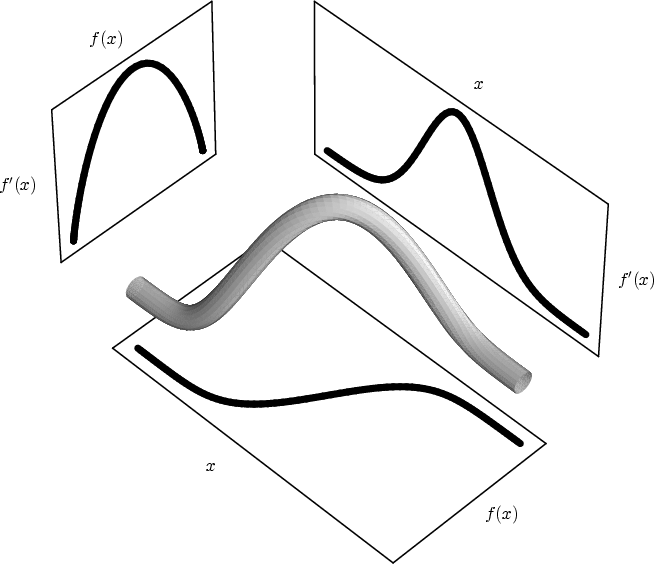
There is a more elaborate conception of the graphs portrayed in Figure 3.5(b) that is well worth describing, since it can give us a more intuitive feel for why those graphs have their particular shape. For the time being, consider just the relationship between data value and the first derivative. Both of these quantities are functions of position, so we could draw a three dimensional graph showing this, as in Figure 3.6.
 |
The same can be done for the relationship between data value and its second derivative, as seen in Figure 3.7.
 |
Now that Figure 3.5(b) is more thoroughly motivated, we can represent its content in a different way. Since we have ``projected away'' position information and reformulated the first and second derivatives as functions of data value, we can create a three dimensional plot of the first and second derivatives as functions of data value, as seen in Figure 3.8.
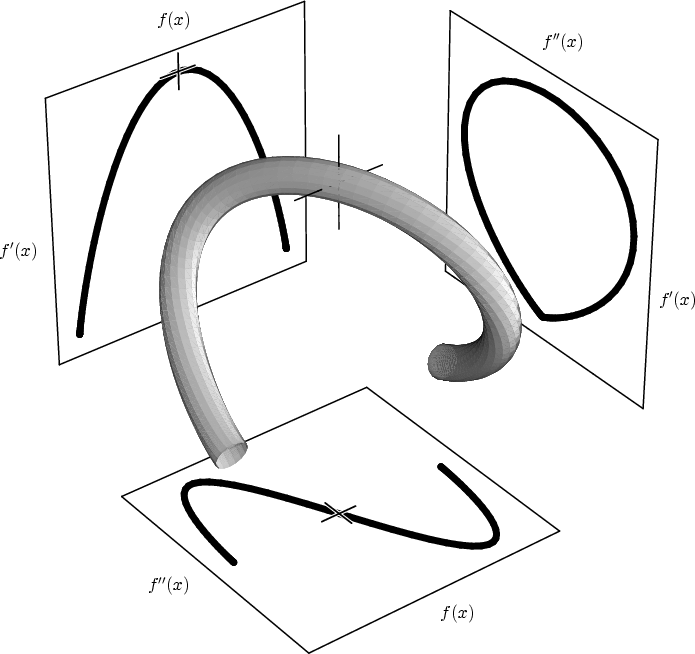 |
The significance of these curves, the three dimensional one as well as
its projections, is that they provide a basis for automatically
generating opacity functions. By analyzing an ideal boundary we have
arrived at a position-independent relationship between the data value
and its derivatives. Therefore, if a three dimensional record of
the relationship between ,  and
and  for a given dataset
contains curves of the type shown in Figure 3.8, we can
assume that they are manifestations of boundaries in the volume.
With a tool to detect those curves and their position, one could
generate an opacity function which makes the data values corresponding
to the middle of the boundary (indicated with cross-hairs) the most
opaque, and the resulting rendering should show the detected
boundaries. Short of that, one could use a measure which responds to
some specific feature of the curve (the zero crossing in , or the
maximum in ) and base an opacity function on that. This is the
approach taken in this thesis.
for a given dataset
contains curves of the type shown in Figure 3.8, we can
assume that they are manifestations of boundaries in the volume.
With a tool to detect those curves and their position, one could
generate an opacity function which makes the data values corresponding
to the middle of the boundary (indicated with cross-hairs) the most
opaque, and the resulting rendering should show the detected
boundaries. Short of that, one could use a measure which responds to
some specific feature of the curve (the zero crossing in , or the
maximum in ) and base an opacity function on that. This is the
approach taken in this thesis.
and its derivatives has been measured does
not lie directly between large regions of two distinct materials, the
monotonicity condition may not hold. Again, we rely on the
statistical properties of the histogram to provide the overall picture
of the boundary characteristics.
 is projected along the three different axes so
as to demonstrate the relationship between each pair of variables.
is projected along the three different axes so
as to demonstrate the relationship between each pair of variables.