


 ,
,  , and
, and  in a boundary
Even though the first and second directional derivatives are
quantities defined in three dimensions, the significant relationship
between them can be reduced to a one dimensional case,
because we only care about the value and its derivatives as we move
along the gradient direction. Thus, in analyzing the relationship
between , , and , it suffices to study a one dimensional
sampling perpendicular to the surface. Figure 3.4
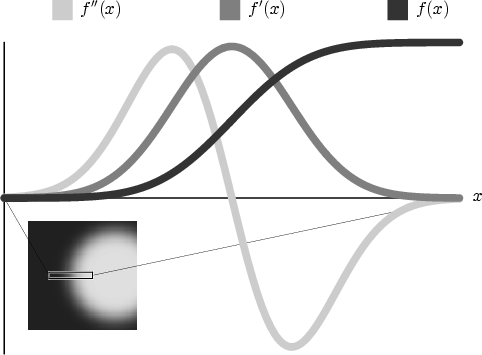 |
and its directional derivatives is
constant, because the boundary is assumed uniform everywhere. Note
that at the mid-point of the boundary, the first derivative is at a
maximum, and the second derivative has a zero-crossing. Because of
blurring, the boundary is spread over a range of positions, but the
maximum in and/or the zero-crossing in provides a way to
define an exact spatial location of a boundary. Indeed, two edge
detectors common in computer vision, Canny
[Can86] and Marr-Hildreth [MH80], use the and
criteria, respectively, to find edges.