


Next: Relationship to edge detection,
Up: Introduction
Previous: The task of finding
Direct volume rendering of boundaries
The question could be asked- ``If the goal is to render the boundaries
of objects, why is direct volume rendering being used, as opposed to
isosurface rendering?'' The standard argument for direct volume
rendering as opposed to isosurface rendering is that in the former,
``every voxel contributes to the final image'', while in the
isosurface rendering, only a small fraction of voxels (those
containing the isovalue) contribute to the final image [Lev88].
This argument is not very convincing, since there is no consistent
correlation between the quality of the image and the number of voxels
contributing to its formation. Too many opaque voxels result in a
cloudy image, or an image where an interesting portion of the
structure is unintentionally obscured. It is just as important that
the transfer function leave some parts of the volume transparent as it
is that it make the interesting parts opaque; otherwise the volume
rendered image would provide no additional insight into the structure
of the volume.
The basic benefit of direct volume rendering over isosurface rendering
is that it provides much greater flexibility in determining how the
voxels contribute to the final image. Voxels over a range of values
can all contribute to the image, with varying amounts of importance,
depending on the transfer function. Also, while an isosurface can
only show structure based solely on data value, the transfer function
can do so based on other quantities as well, such as gradient
magnitude.
This motivates why direct volume rendering can be used in situations
where the structure of the data is amorphous, as in gaseous
simulations [Max95]. More importantly, it motivates the use
of direct volume rendering in medical imaging situations where there
noise or measurement artifacts distort the isosurfaces away from the
shape of the object boundary. To the extent that the objects'
surfaces are associated with a range of values, the transfer function
for direct volume rendering can make a range of values opaque or
translucent.
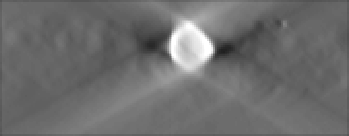
Figure 1.3:
Slice of neuron in tomographic plane. Artifacts from the lack
of projection data at some angles are visible as the bright spots
on either side of the dendrite, as well as the light streaks.
 |
As an example to exhibit the usefulness of direct volume rendering
versus isosurface rendering, consider some neuron data from the CMDA
project. Figure 1.3 shows a slice of a spiny dendrite
dataset. Note the dark regions on either side of the neuron, and the
light streaks which emanate from its top and bottom. These are
artifacts from the tomographic process which reconstructs three
dimensional information from a series of two dimensional projections.
Because there are ranges of angles in which projection data cannot be
obtained, there are orientations for which the quality of the
tomographic reconstruction is poor, causing the surface of the neuron to be
blurred or distorted. A further difficulty is the fact that the
radio-opaque dye which renders the neuron visible is sometimes
absorbed unevenly.
Figure 1.4:
Comparison of volume rendering methods
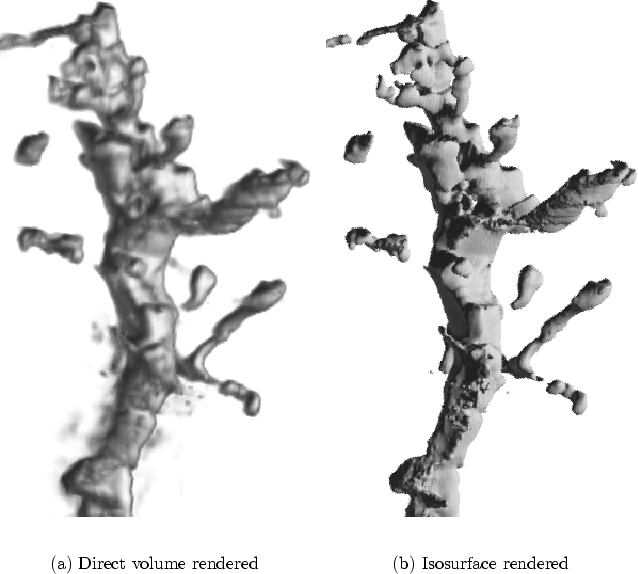 |
Fig. 1.4 shows two renderings of a mammalian
neuron dataset, using the same viewing angle, shading, and lighting
parameters, but rendered with different algorithms: a shear-warp
direct volume rendering produced with the Stanford VolPack rendering
library[LL94] and a non-polygonal ray-cast isosurface
rendering. Towards the bottom of the direct volume rendered image,
there is some fogginess surrounding the surface, and the surface
itself is not very clear. As can be confirmed by looking directly at
slices of the raw data, this corresponds exactly to a region of the
dataset where the material boundary is in fact poorly defined. The
surface rendering, however, shows as distinct a surface here as
everywhere else, and in this case the poor surface definition in the
data is manifested as a region of rough texture. This can be
misleading, as there is no way to know from this rendering alone that
the rough texture is due to measurement artifacts, and not a feature
on the dendrite itself.
Next: Relationship to edge detection,
Up: Introduction
Previous: The task of finding