


We spend the rest of this class with proving the Main technical theorem above.

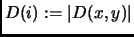 , where
 .
.
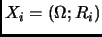 .
Let
.
Let
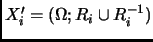 be the corresponding undirected graph.
 at distance
  in
in
 ,
because there exist
,
because there exist  not adjacent in
,
but
is connected by primitivity, and
so the third vertex of any minimal -path is at
distance from
not adjacent in
,
but
is connected by primitivity, and
so the third vertex of any minimal -path is at
distance from  .
.
Now take any
 , not adjacent in
.
Need to show:
, not adjacent in
.
Need to show:
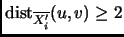 .
Need to show:
.
Need to show:  have a common neighbor in
.
have a common neighbor in
.
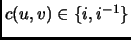 .
Implies # common neighbors of in
is the same as for .
.
Implies # common neighbors of in
is the same as for .


 .
.
 is the complete graph, then
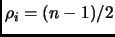 and we are done.
Otherwise, use Lemma
and we are done.
Otherwise, use Lemma ![[*]](file:/opt/latex2html/latex2html-99.2beta6/icons/crossref.gif) and Exercise .
and Exercise .
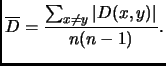
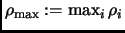 .
.
 such that
 .
This means
.
This means
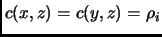 for some
  .
This is
.
This is

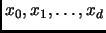 be a in
  path where
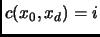 .
.
 .
The size on the left side is
.
The size on the left side is  ; all stes on the right side have size
 .
.
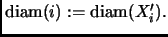
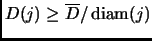 .
.
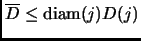 .
Pick such that
.
Pick such that
 .
Then
.
Then
 .
.
 be a shortest path from
  to
to  in .
Let
in .
Let
 neighbors of in color
  .
.
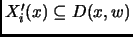 and
and
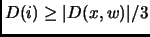 .
The Lemma is immediate from the following claim:
.
The Lemma is immediate from the following claim:
The claim is easy: if some -neighbor  of
did not distinguish from then
of
did not distinguish from then
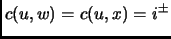 ,
so
,
so  would be an -path of length 2, contradicting
the assumption that
would be an -path of length 2, contradicting
the assumption that
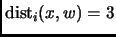 . Now
. Now
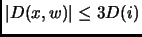 by Lemma .
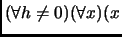 distinguishes at least
  pairs
of color
pairs
of color 
 .
.
 using the set
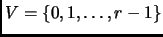 of colors as vertex set.
Let
of colors as vertex set.
Let  be the number of edges of color or
  from
from  to
to  . Put an edge between and
  if
if
 ; assign weight to this edge.
It follows from Exerciseconn-ex that if there is an
; assign weight to this edge.
It follows from Exerciseconn-ex that if there is an
 edge then
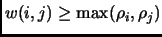 .
.
is a connected graph. This follows from the primitivity
of
 (why?). Let
  be a spanning tree of .
Let us orient away from vertex (color) 0.
distinguishes
be a spanning tree of .
Let us orient away from vertex (color) 0.
distinguishes  edges of color , where
 total weight of edges of .
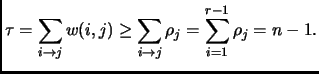
 in two different ways.
Count by  . The number of pairs such that
 is
is  .
For each such pair, there are choices for . Thus,
.
For each such pair, there are choices for . Thus,
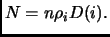
Now count by . There are  choices for . Given , there are
at least pairs distinguished by . Thus
choices for . Given , there are
at least pairs distinguished by . Thus

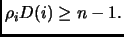
 then
then
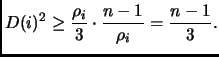
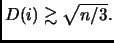 from Lemma
and Corollary , we get
from Lemma
and Corollary , we get
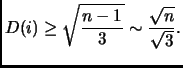 ,
completes the proof of the Main Theorem.
,
completes the proof of the Main Theorem.
This proof is based on L. Babai: ``On the order of uniprimitive
permutation groups,'' Annals of Math. 113 (1981), 553-568,
as simplified by N. Zemlyachenko a year later.
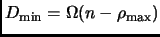 . (Note that this is true
for the average rather than the minimum size of distinguishing sets
by Lemma .)
. (Note that this is true
for the average rather than the minimum size of distinguishing sets
by Lemma .)Another open question:
 ,
,
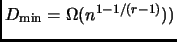 .
Or at least
.
Or at least
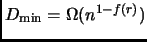 , where
 .
. .
.
 , if
, if 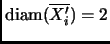 .
.
 .
.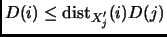 .
. then
then
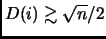 .
. then
then
 .
.
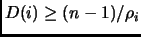 .
.