


 , the largest four primitive permutation groups
are
, the largest four primitive permutation groups
are  and
and  , of order about
  , and
, and  (for
(for
 ) and
) and
 (for
(for  ),
of order about
),
of order about
 .
The classification of finite simple groups allows us
to show that these are the largest and even to list the
largest down to size about
.
The classification of finite simple groups allows us
to show that these are the largest and even to list the
largest down to size about
 . We can do
reasonably well with elementary means.
. We can do
reasonably well with elementary means.
 ,
,
 , and
, and  is primitive.
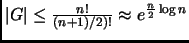 .
.
 .
is not doubly transitive,
.
is not doubly transitive,
 (using almost only graph theory).

The following theorem si proved using the classification of finite simple groups; one can get close by elementary means.
 ,
,
 is doubly transitive then


Remarks about symmetry and regularity: symmerty conditions are given in terms of automorphisms; regularity conditions in terms of numerical parameters. Symmetry condition imply regularity conditions (e.g., vertex-transitivity is a symmetry condition, which implies that the graph is regular, a regularity condition). The converse is seldom true. We shall define regularity conditions on a family of edge-colored digraphs which capture some combinatorial consequences of primitive group action. Using this translation, we shall prove a combinatorial result which implies a nearly optimal upper bound on the order of uniprimitive (primitive but not doubly transitive) permutation groups.
Picture of  .
.
 , diagonal.
 .
.
 # colors = # orbits of on
 .
has rank
.
has rank  ,
,  .
In this case, all orbitals are self-paired.
.
In this case, all orbitals are self-paired.
 of a permutation group
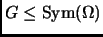 is an orbit of on the set of ordered pairs
(
is an orbit of on the set of ordered pairs
(
 ). is
self-paired when
). is
self-paired when
 (i.e.,
for
(i.e.,
for
 there exists
 such that
 and
and
 ).
The rank
).
The rank  of a permutation group is the number of its
orbitals.
of a permutation group is the number of its
orbitals.

:
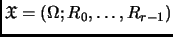 ,
,
 .
.
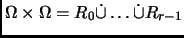 .
.
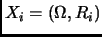 ,
,  'th color digraph, called a
constituent digraph.
The color of a pair
'th color digraph, called a
constituent digraph.
The color of a pair  is defined as
 if
if
 .
.
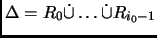 .
Equivalently,
.
Equivalently,
 .
.
 .
Terminology:
.
Terminology:  is self-paired if
 , i.e.,
  is undirected.

 ,
,
 orbitals
 . We refer to these as ``the group case.''


Well, we always lose in translation. The question is how much.

 is homogeneous if
 (i.e.,
 ).
).



By the way,
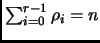 , since every vertex is connected
to every other (including itself) in the graph
, since every vertex is connected
to every other (including itself) in the graph  , whose edge
set contains all
, whose edge
set contains all  ordered pairs.
is a primitive coherent configuration if
is homogeneous and ALL constituent digraphs ,  are connected.


 ,
,
 .
Look at the pointwise stabilizer,
.
Look at the pointwise stabilizer,  ,
,
 .
If
.
If
 , then
 ,
in fact
,
in fact
 .
Call such a
.
Call such a  a ``fixing set.''
We shall prove, using only elementary graph theoretic arguments, that
is uniprimitive, then
 and
and  .
.Examples: How large is the smallest fixing set for various classes of permutation groups?

is any set
 such that
 .
In other words, for every pair , contains an element
which distinguishes them.
.
In other words, for every pair , contains an element
which distinguishes them.

Theorem ![[*]](file:/opt/latex2html/latex2html-99.2beta6/icons/crossref.gif) will follow from the following result.
will follow from the following result.
is a uniprimitive coherent configuration, then
there exists a distinguishing set such that
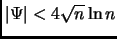 .
.
This will be an immediate consequence of the following.
From now on, let us always assume
is a uniprimitive
coherent configuration.
 Theorem ].
Pick
Theorem ].
Pick
 at random, and hope that we picked
enough to hit each
at random, and hope that we picked
enough to hit each  .
.
 not hit not hit |
 |
 |
|
 |
 |
 not hit not hit |
 |
 |
|
|
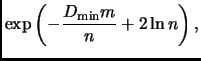 |
 .
.
For this, it is sufficient to show
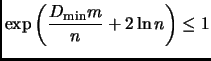
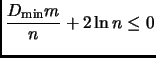
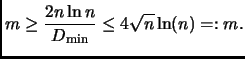
 .
.

 .
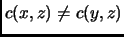
. .
. distinguishes
  and
and  if
if
 .
.
 is the distinguishing set
for
is the distinguishing set
for  .
.