


 (in which the edges
are called lines) such that
(in which the edges
are called lines) such that
 is 3-uniform);
In other words, a STS satisfies condition (C1) above and is maximal with
that property: The number of edges is exactly equal to the upper bound
obtained above:
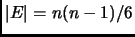 , where
  is the number of vertices.
In particular we must have that
is the number of vertices.
In particular we must have that  is divisible by 6.


This necessary condition on also turns out to be sufficient.
We construct a STS  on 7 vertices (with 7 edges) as follows: Take the
vertices of a(n equilateral) triangle along with the bisectors of the edges
and the (in)center of the triangle. Let the edges of the STS consist of the
following:
on 7 vertices (with 7 edges) as follows: Take the
vertices of a(n equilateral) triangle along with the bisectors of the edges
and the (in)center of the triangle. Let the edges of the STS consist of the
following:
This configuration is called the ``Fano Plane'' see Figure ![[*]](file:/opt/latex2html/latex2html-99.2beta6/icons/crossref.gif) .
.
The incidence matrix for the Fano plane is as follows (the rows correspond to lines, columns to points, ``1" indicates incidence):
| 0 | 1 | 2 | 3 | 4 | 5 | 6 | |
| a | 1 | 1 | 0 | 1 | 0 | 0 | 0 |
| b | 0 | 1 | 1 | 0 | 1 | 0 | 0 |
| c | 0 | 0 | 1 | 1 | 0 | 1 | 0 |
| d | 0 | 0 | 0 | 1 | 1 | 0 | 1 |
| e | 1 | 0 | 0 | 0 | 1 | 1 | 0 |
| f | 0 | 1 | 0 | 0 | 0 | 1 | 1 |
| g | 1 | 0 | 1 | 0 | 0 | 0 | 1 |
53#2
The group of automorphisms of the Fano plane is a very important group: it is the second smallest finite simple group. ``Simple groups'' to ``groups'' are like ``atoms'' to ``chemical compounds,'' so according to this analogy, the automorphism group of the Fano plane is the ``Helium of group theory.''
55#4
57#6