


Before we can create histogram volumes, there are
several implementation issues that need to be resolved, starting with
the spatial resolution of the grid on which we sample  ,
,  , and
, and
 throughout the volume. If the grid is too sparse, we risk
missing the boundary. Instead of having a dense and continuous
distribution of ``hits'' in the histogram volume, we would have only
sparse or broken coverage of the curves we are looking for. If the
grid is too dense, we have excess computation.
throughout the volume. If the grid is too sparse, we risk
missing the boundary. Instead of having a dense and continuous
distribution of ``hits'' in the histogram volume, we would have only
sparse or broken coverage of the curves we are looking for. If the
grid is too dense, we have excess computation.
The approach taken in this thesis is to measure , , and
exactly once per voxel, at the original sample points of the dataset.
There are two reasons for this. First is ease of computation.
Because we are working only with the original data points of the
volume, there is no need to perform reconstruction to measure , and
the measurements of and are greatly facilitated by the use
of masks, a computational tool to measure properties of discrete
data. These will be explained shortly. Second, because bandlimiting
ensures that there is always some boundary blurring, and because the
boundaries of real objects are apt to assume a variety of positions
and orientations relative to the sampling grid, sampling over the
whole dataset will insure that the sample points fall at a variety of
positions within the boundary region, leading to more complete
coverage of the curves in the scatterplots and histogram volume. Of
course, the more bandlimiting there is, the more blurred the
boundaries will be, leading to a greater accumulation of hits along
the curves in the histogram volume and in the scatterplots. A more
mathematical treatment of this relationship is given in
Appendix A.
The remaining implementation issues of histogram volume creation are unfortunately matters of parameter setting. Though the goal of this research is to reduce the total number of parameters that need to be adjusted before informative renderings can be achieved, there are in fact a few input parameters necessary for the creation of the histogram volume itself. This is why the generation of transfer functions is (at best) semi-automatic.
One variable in the histogram volume creation is the histogram
resolution, that is, how many bins to use. The trade-off here is
between the large storage and processing requirements caused by having
many bins, and the inability to resolve patterns in the histogram
volume caused by having too few. In our experiments, good results
have been obtained with histogram volumes of sizes between  and
and
 , though there is no reason that the histogram volumes need to
have equal resolution on each axis. In general, better results have
been obtained from using larger histogram volumes. While a
volume does not represent an exceedingly large storage or
computational challenge to modern systems, the ability to get decent
results from, for instance, a
, though there is no reason that the histogram volumes need to
have equal resolution on each axis. In general, better results have
been obtained from using larger histogram volumes. While a
volume does not represent an exceedingly large storage or
computational challenge to modern systems, the ability to get decent
results from, for instance, a  histogram volume, with the
associated nearly 8-fold speed increase, makes the use of smaller
histogram volumes an attractive alternative. A brief comparison of
results from using different size histogram volumes is given in
Chapter 6.
histogram volume, with the
associated nearly 8-fold speed increase, makes the use of smaller
histogram volumes an attractive alternative. A brief comparison of
results from using different size histogram volumes is given in
Chapter 6.
A more significant issue is the the range of values that each axis of the histogram volume should represent. Obviously along the data value axis, we should include the full range, since we want to capture all the values at which boundaries might occur. But along the axes for the first and second derivatives, it may make sense to include something less than the full range. This is because derivative measures are by nature very sensitive to noise, and thus will take on very high (or very low) values wherever noise occurs. If significant noise is present in the volume data, and if we included the full range of derivative values in the histogram volume, then the important and meaningful sub-range of derivative values might be compressed to a relatively small number of bins. This would hamper the later step of detecting patterns in the histogram volume. Of course, we have no a priori way of knowing what the meaningful ranges of derivatives values are. Currently, the derivative value ranges are set by hand, and this is a subject in need of further research.
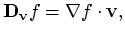
The most significant implementation issue is the method of measuring the first and second directional derivatives. The first derivative is actually just the gradient magnitude. From vector calculus [MT96] we have:
 |
(1) |
 , the second directional
derivative along the gradient direction. Twice applying
Equation 4.2 gives:
along
, the second directional
derivative along the gradient direction. Twice applying
Equation 4.2 gives:
along
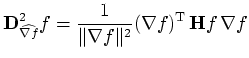
 [Fau93] gives:
 is the Hessian of , a
 matrix of
second partial derivatives of [MT96].
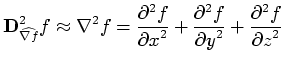
Alternatively, we can use the Laplacian
matrix of
second partial derivatives of [MT96].
Alternatively, we can use the Laplacian
 to approximate
:
to approximate
:
As all these derivative measures require taking first or second
partial derivatives of the data along the axial directions, we need to
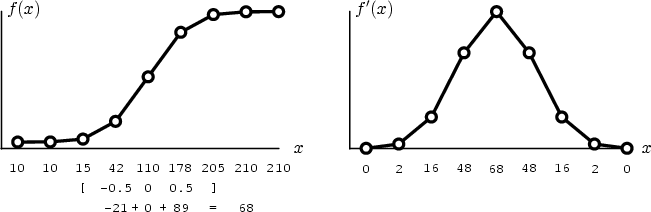
develop masks which can measure these quantities. Masks are vectors
of scalar weights, designed to measure certain properties of sampled
data. The mask is centered at the sample point of interest, and the
products between corresponding mask weights and sample values are
summed to produce the final measurement. The combination of weights
in the mask determine its functionality. As a simple example,
Figure 4.3 demonstrates a mask (
![$ [-0.5~~0~~0.5]$](img64.gif) ) which
measures the first derivative of one dimensional data.
) which
measures the first derivative of one dimensional data.
 |
Even though we have a way of measuring all the necessary partial
derivatives in the volume, we still need to chose among the different
measurement approaches for
.
Each of the three expressions for
given above suggest different implementations. While the
Hessian method (Equation 4.4) has been found to be the most
numerically accurate, the others have proven sufficiently accurate in
practice to make them appealing by virtue of their computation
efficiency. The Laplacian (Equation 4.5) computation is direct and
inexpensive, but the most sensitive to quantization noise. The
gradient of the gradient magnitude (Equation 4.3) is better, and
its computational expense is lessened if the gradient magnitude has
already been computed everywhere for the sake of volume rendering
(e.g., as part of shading calculations). A more thorough
characterization of the different second derivative measures is given
in Appendix C. Deciding which derivative measures to use
is the final parameter for histogram volume creation.
We can now give an algorithm for histogram volume creation:
and , and the lowest value of . (Assume zero for the lowest
value of ). Set ranges on the histogram volume axes accordingly., , and at each sample point,, , and , and


 ,
,  , and
, and  are multiplied
by the mask values
are multiplied
by the mask values  , 0, and
  respectively, and the
products are summed to produce the final measurement.
respectively, and the
products are summed to produce the final measurement.