Our goal here is to show the relationship between the boundary's
frequency content and its thickness, and how this relationship effects
our ability to record the presence of the boundary in the histogram
volume. The Fourier transform is an important part of this analysis,
and because there are variety of possible definitions for the
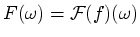
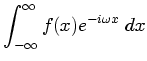
transform, we state the particular definitions being used here:
 |
 |
 |
(22) |
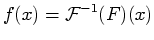 |
|
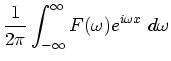 |
(23) |
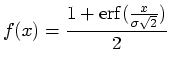
We will use the following to model the data value as a function of position within a boundary region:
 . Setting
 and
and
 in the the formula for
  given in Section 5.1
produces Equation A.3. Any other values for the variables
given in Section 5.1
produces Equation A.3. Any other values for the variables
 and
and  represent some scaling or shifting of the
boundary, and the Fourier transform is not meaningfully changed by
these operations.
represent some scaling or shifting of the
boundary, and the Fourier transform is not meaningfully changed by
these operations.
To find the Fourier transform of the given above, we could
simply apply the definition of the Fourier transform to , and
then reduce the resulting expression. We can avoid this labor,
however, by exploiting a useful property of the transform under
integration, expressed here with
 pointing to the two
expressions which are transforms of each other:
pointing to the two
expressions which are transforms of each other:
 and its Fourier transform
 , how to find the transform of an integral if we already know
the transform of the function being integrated. Aside from a ``DC''
term
, how to find the transform of an integral if we already know
the transform of the function being integrated. Aside from a ``DC''
term
 (which we will henceforth ignore18),
when we integrate a function, the corresponding transform is divided
by
(which we will henceforth ignore18),
when we integrate a function, the corresponding transform is divided
by  . We will use
Equation A.4 to find the transform of because
doing so will bring us directly in contact with the attenuation in
frequency space caused by the bandlimiting inherent in the
measurement.
. We will use
Equation A.4 to find the transform of because
doing so will bring us directly in contact with the attenuation in
frequency space caused by the bandlimiting inherent in the
measurement.
In order to exploit the property expressed in
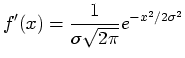
Equation A.4, we find the derivative of :
 |
(26) |
,  is a normalized Gaussian function
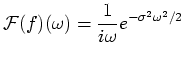
with standard deviation . Its Fourier transform is[KK68]:
is a normalized Gaussian function
with standard deviation . Its Fourier transform is[KK68]:
 |
(27) |
is ,
in
 it is
it is  . Having and its
transform
, we can now use
Equation A.4 to state the transform of the
measured boundary function:
. Having and its
transform
, we can now use
Equation A.4 to state the transform of the
measured boundary function:
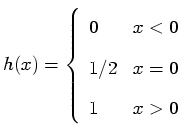
It is possible to utilize the same process to find the transform
of the un-blurred boundary function, which represents the boundary prior
to the measurement process. This is the so-called Heaviside step
function  :
:
 |
(29) |
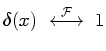
 . The Fourier transform of the
delta function is trivial to compute:
. The Fourier transform of the
delta function is trivial to compute:
 |
(30) |
 |
(31) |
 (Equation A.7) that the spectrum of the measured boundary
is the product of the spectrum of the step function (
(Equation A.7) that the spectrum of the measured boundary
is the product of the spectrum of the step function ( ) times a
Gaussian function
) times a
Gaussian function
 . Thus,
is
precisely the attenuation in frequency caused by the bandlimiting in
the measurement process. We can now state the relationship between
measured boundary thickness and bandlimiting:
. Thus,
is
precisely the attenuation in frequency caused by the bandlimiting in
the measurement process. We can now state the relationship between
measured boundary thickness and bandlimiting:
The boundary thickness will be