In order to develop a method for opacity function generation that uses our boundary model and the information stored in the histogram volume, we need to look at the equation used to describe the ideal boundary data value as a function of position, as plotted in Figure 3.4:
 function. We define this important function and
plot it in Figure 5.1.
function. We define this important function and
plot it in Figure 5.1.
 |
(7) |
is centered
around the origin, the boundary function  is also centered
around where position
is also centered
around where position  is zero. There are two essential
differences between and
is zero. There are two essential
differences between and
 . First, in the
argument of
is scaled by
. First, in the
argument of
is scaled by
 . The
. The  parameter
controls the thickness, or spread, of the boundary. For large ,
the argument of
is reduced, and the boundary is stretched out
more. The boundary is much narrower and sharper with a small .
Second,
's range has been shifted and scaled so that the range
of is between
parameter
controls the thickness, or spread, of the boundary. For large ,
the argument of
is reduced, and the boundary is stretched out
more. The boundary is much narrower and sharper with a small .
Second,
's range has been shifted and scaled so that the range
of is between  and
and  . As approaches
negative infinity,
. As approaches
negative infinity,
 approaches
  , and
thus approaches . Conversely, as approaches
positive infinity, approaches . At
, and
thus approaches . Conversely, as approaches
positive infinity, approaches . At  , the middle
of the boundary, is half-way between and .
, the middle
of the boundary, is half-way between and .
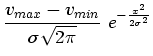
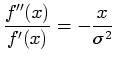
The first and second derivatives of  are as follows:
 is a
normalized Gaussian, with being the usual standard deviation.
is a
normalized Gaussian, with being the usual standard deviation.
 |
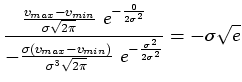
 , this is where
 attains its extrema. The same positions can serve as
(somewhat artificial) delimiters for the extent of the boundary. We
define the ``thickness'' of the boundary to be
attains its extrema. The same positions can serve as
(somewhat artificial) delimiters for the extent of the boundary. We
define the ``thickness'' of the boundary to be  .
Figure 5.2 shows how the the definition of thickness
roughly accounts for the region in which the data value transitions
between the values on either side of the boundary.
.
Figure 5.2 shows how the the definition of thickness
roughly accounts for the region in which the data value transitions
between the values on either side of the boundary.
The equations for (Equation 5.3) and
(Equation 5.4) look very similar because of the special
derivative properties of  . In fact, the only difference between
and is a scaling factor
. In fact, the only difference between
and is a scaling factor
 and the
position :
and the
position :
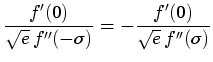
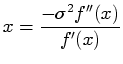
along a boundary knowing just and the first and second
derivatives. can be recovered if the extremal values of and
are known. Recall from Figure 5.2 that
has its maximum at 0, and that has a maximum at  and a minimum at . This gives us two different ways of calculating .
, one can then recover position from and with
Equation 5.5:
and a minimum at . This gives us two different ways of calculating .
, one can then recover position from and with
Equation 5.5:
Section 3.4 described the ability to transform
the first and second derivatives as functions of position into
functions of data value. That transformation takes on special
importance in light of Equation 5.7.  and
and  are
functions of position in that equation, but there is no reason why
they couldn't also be functions of data value. In that case, we would
have a way to map from data value back to position along a boundary.
Since our goal is to produce an opacity function which makes the
middle of boundaries opaque, this information is exactly what is
necessary for opacity function generation.
are
functions of position in that equation, but there is no reason why
they couldn't also be functions of data value. In that case, we would
have a way to map from data value back to position along a boundary.
Since our goal is to produce an opacity function which makes the
middle of boundaries opaque, this information is exactly what is
necessary for opacity function generation.
Fortunately, the histogram volume contains that information. The
histogram volume was created by recording the position-independent
relationship between the data value and its derivatives. In that
case, the position that was ``projected out'' in the histogram
formation was the  position within the volume. Now, having
created the histogram volume, in the next section we will analyze it
in order to re-create ``position'' information with
Equation 5.7. This time, the ``position'' in question is
actually a signed distance to the nearest boundary, which will be
extremely helpful in the creation of opacity functions.
position within the volume. Now, having
created the histogram volume, in the next section we will analyze it
in order to re-create ``position'' information with
Equation 5.7. This time, the ``position'' in question is
actually a signed distance to the nearest boundary, which will be
extremely helpful in the creation of opacity functions.

![\begin{figure}
\centering {
\psfrag{erfx}[bc]{\raisebox{8pt}{$y = \operatorname...
...pace{4pt}$x$}
\epsfig {figure=eps/erf.eps, width=0.5\columnwidth}}
\end{figure}](img83.gif)