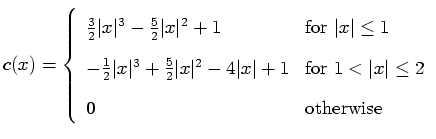
Figure 4.3 demonstrated the use of a simple mask which was used to measure the first derivative in one dimensional data. This appendix will describe a process which produces masks for measuring derivatives in one dimension, as well as how to generalize one dimensional masks to measure first and second partial derivatives in three dimensions19.
It was stated in Chapter 4 that reconstruction of a continuous data value function between sample points in the volume dataset is not necessary for measuring any of the quantities needed in the histogram volume creation. Instead, discrete masks can be used to measure the first and second partial derivatives which are needed for the directional derivative calculations. Although we will not need to explicitly reconstruct the data value anywhere, a simple way to derive the necessary masks is through consideration of reconstruction filters and convolution.
Given a sequence of sampled data points  , the creation of a
continuous function which interpolates smoothly between them starts
with a train of delta function spikes at unit intervals, scaled
by the original data values:
, the creation of a
continuous function which interpolates smoothly between them starts
with a train of delta function spikes at unit intervals, scaled
by the original data values:
 with a continuous kernel
  :
:
 |
(36) |
, and one
containing evaluations of the derivative of the kernel  . If the
position
. If the
position  where we calculate the derivative of the reconstructed
function happens to be an integer
where we calculate the derivative of the reconstructed
function happens to be an integer  , we can express this as:
has finite support, there
can only be a finite number of non-zero values in the vector
, we can express this as:
has finite support, there
can only be a finite number of non-zero values in the vector
![$ \left[\cdots\,\!h'(2)\,h'(1)\,h'(0)\,h'(-1)\,h'(-2)\,\!\cdots\right]$](img247.gif) . The
finite vector containing all the non-zero values is a mask for
measuring the first derivative of regularly sampled data. Since most
reconstruction kernels are even functions (
. The
finite vector containing all the non-zero values is a mask for
measuring the first derivative of regularly sampled data. Since most
reconstruction kernels are even functions (
 ), the mask
will have an odd number of values, with
), the mask
will have an odd number of values, with  at the center
position. Equation B.4 shows how a mask is used:
after centering the mask at the data point of interest (
at the center
position. Equation B.4 shows how a mask is used:
after centering the mask at the data point of interest ( ), the
products between corresponding data and mask values are summed to
produce the final measurement.
), the
products between corresponding data and mask values are summed to
produce the final measurement.
Given any continuous reconstruction kernel , we can evaluate its
first derivative at integer positions to generate a first derivative
mask. Of course, the first derivative has to exist at the integer
positions in order for this to be valid. As an example, we take the
Catmull-Rom cubic spline  :
:
 is continuous; evaluating at the
integers yields:
is continuous; evaluating at the
integers yields:
![$\displaystyle [\cdots~~c'(2)~~c'(1)~~c'(0)~~c'(-1)~~c'(-2)~~\cdots] = [\cdots~~0~-0.5~~0~~0.5~~0~~\cdots]$](img254.gif) |
(40) |
![$ [-0.5~~0~~0.5]$](img64.gif) .
.
In the same way that first derivative masks were derived above, masks
for measuring the second derivative of regularly
sampled data can be created from a kernel :
![$\displaystyle [\cdots~~h''(2)~~h''(1)~~h''(0)~~h''(-1)~~h''(-2)~~\cdots]$](img255.gif) |
twice, one will
find that the Catmull-Rom kernel does not generate a second derivative mask
because its second derivative is discontinuous at  and
and  .
.




![$\displaystyle \left[\cdots~v_{-1}~v_{0}~v_{1}~v_{2}~\cdots\right]^T \left[\cdots~h'(x+1)~h'(x)~h'(x-1)~h'(x-2)~\cdots\right]$](img243.gif)

![$\displaystyle \left[\cdots~v_{k-2}~v_{k-1}~v_{k}~v_{k+1}~v_{k+2}~\cdots\right]^T \left[\cdots~h'(2)~h'(1)~h'(0)~h'(-1)~h'(-2)~\cdots\right]$](img246.gif)