


As was noted in Section 4.3, a common mask for
measuring the first derivative is
![$ [-0.5~~0~~0.5]$](img64.gif) , called the
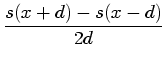
``central difference'' method. The name arises from the derivative
approximation for a function
, called the
``central difference'' method. The name arises from the derivative
approximation for a function  :
:
 |
 |
 |
|
 |
 |
||
|
![$\displaystyle [s(x-d)~~s(x)~~s(x+d)]^T~[\frac{1}{2d}~~0~-\frac{1}{2d}]$](img262.gif) |
(41) |
 gives the
mask. In the interests of
implementation simplicity and computational speed, this thesis adopts
central differences for the first derivative mask. In the context
of volume rendering, central differences are often used to calculated
the gradient magnitude as part of the shading
calculations [LCN98]. There are more sophisticated derivative
measurement techniques available [MMMY96], but a thorough
exploration of them is tangential to the goal of this thesis.
gives the
mask. In the interests of
implementation simplicity and computational speed, this thesis adopts
central differences for the first derivative mask. In the context
of volume rendering, central differences are often used to calculated
the gradient magnitude as part of the shading
calculations [LCN98]. There are more sophisticated derivative
measurement techniques available [MMMY96], but a thorough
exploration of them is tangential to the goal of this thesis.
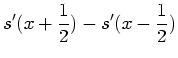
There is another simple and common mask for our second derivative
measurement, ![$ [1~-2~~1]$](img264.gif) , sometimes called the ``second central
difference'' method. The name arises from the fact that the mask can
be derived by twice applying the method of central differences (now
with
, sometimes called the ``second central
difference'' method. The name arises from the fact that the mask can
be derived by twice applying the method of central differences (now
with  ), as follows:
 |
|
 |
|
|
 |
||
|
 |
||
|
![$\displaystyle [s(x-1)~~s(x)~~s(x+1)]^T~[1~-2~~1]$](img270.gif) |
(42) |
for the second derivative mask, again in the interests of
implementation simplicity and computational speed.
There is an important theoretical question regarding the validity of
using these two masks in combination for the histogram volume
computation. Recall from Chapter 3 that we traced
along an ideal boundary to reveal a characteristic relationship
between the data value and its first and second derivatives, as
illustrated in Figure 3.8. The point
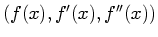 was plotted for each position
  along the
boundary in order to form the three dimensional curve
which indicates the presence of a boundary. For such a case, the
boundary function
along the
boundary in order to form the three dimensional curve
which indicates the presence of a boundary. For such a case, the
boundary function  studied was a continuous function with
analytically known derivatives, thus reconstruction was not an issue.
studied was a continuous function with
analytically known derivatives, thus reconstruction was not an issue.
However, when we are measuring derivatives of sampled data with masks, we are implicitly reconstructing the function. That is, the result of using a mask is mathematically equivalent to convolving the sample points with a continuous kernel and analytically finding the derivative of the reconstructed function. Thus, there is a basic incompatibility if there does not exist a reconstruction kernel which can generate both the first and second derivative masks being used. For such a case, the first and second derivatives measures would be based on different reconstructions of the same data. There is no guarantee that the relationship observed in Figure 3.8 will hold if the first and second derivatives are taken from entirely different functions.
It is therefore imperative that we find a reconstruction kernel which
generates
and as its first and second
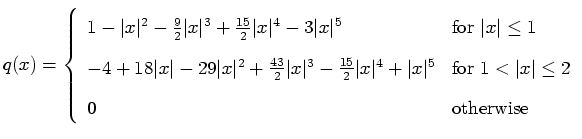
derivative masks, respectively. A piece-wise quintic polynomial
kernel  was found which has all the necessary derivative
characteristics20:
was found which has all the necessary derivative
characteristics20:
 |
(43) |
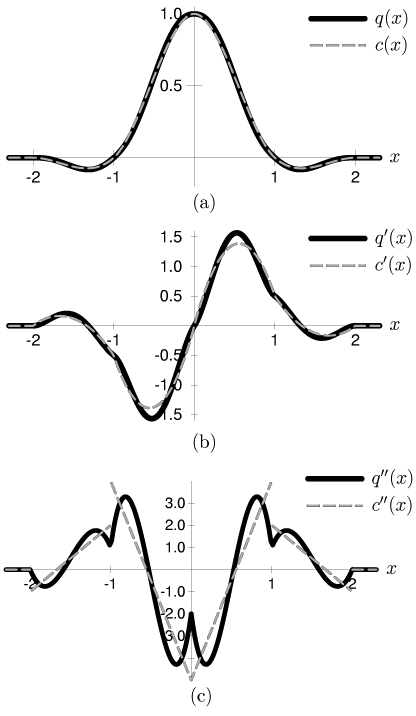 |
looks very similar to the Catmull-Rom kernel  (also plotted) the differences become apparent upon taking
derivatives, revealing that is a higher degree polynomial
than . Because , unlike , has continuous second
derivatives, it can be used to generate a second derivative mask.
(also plotted) the differences become apparent upon taking
derivatives, revealing that is a higher degree polynomial
than . Because , unlike , has continuous second
derivatives, it can be used to generate a second derivative mask.
This quintic kernel was never implemented in the software for histogram volume generation, because it was never needed for any derivative measurements. Rather, its mere existence provides necessary justification for the approach taken in this thesis. It insures that there is some reconstruction of the sampled data which is consistent with the masks utilized for measuring derivatives. Equation B.3, and its analog for the second derivative, prove that the two masks we have chosen provide exact measures for the first and second derivatives of the data value as a continuous function of position, for the case where the data value was reconstructed with this quintic interpolation kernel.