


The two masks discussed thus far (
![$ [-0.5~~0~~0.5]$](img64.gif) for first
derivative and
for first
derivative and ![$ [1~-2~~1]$](img264.gif) for second derivative) are only
useful for measuring the derivatives of one dimensional data. These
are now generalized to create masks for measuring first and second
partial derivatives of sampled data in three dimensions.
for second derivative) are only
useful for measuring the derivatives of one dimensional data. These
are now generalized to create masks for measuring first and second
partial derivatives of sampled data in three dimensions.
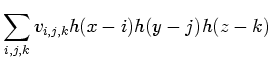
Any reconstruction kernel  in one dimension can be trivially
extended to a separable kernel
in one dimension can be trivially
extended to a separable kernel
 in three dimensions:
 , where
  all range over the integers:
 |
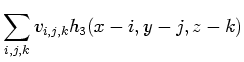
 is a lattice of kernels scaled by
the data values:
is a lattice of kernels scaled by
the data values:
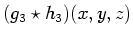 |
 |
 |
|
|
 |
 |
|
 |
|
 |
|
 |
|
 |
|
 |
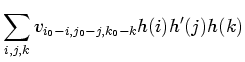
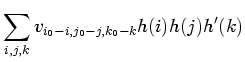
 on the integer lattice:
Whereas the one dimensional mask was a vector of evaluations of
 ,
we now have a three dimensional lattice of evaluations of a partial
derivative of
,
we now have a three dimensional lattice of evaluations of a partial
derivative of  . These are the masks for derivative measurement
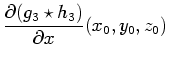
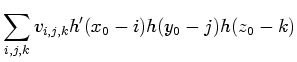
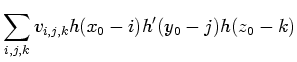
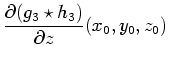
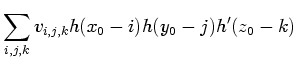
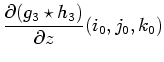
in three dimensions. For example, the mask for calculating the first
partial derivative along the
. These are the masks for derivative measurement
in three dimensions. For example, the mask for calculating the first
partial derivative along the  axis,
axis,
 , is the
lattice of values
, is the
lattice of values
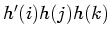 , where all range over
the integers. The mask for the second mixed partial derivative along
the
, where all range over
the integers. The mask for the second mixed partial derivative along
the  and
and  axes,
axes,
 , is the lattice of
values
, is the lattice of
values
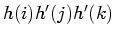 . As before, we assume the kernel
  has
finite support, thus there are only a finite number of non-zero values
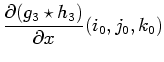
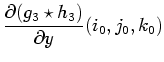
in the masks. Figure B.2 depicts the masks for
and
.
has
finite support, thus there are only a finite number of non-zero values
in the masks. Figure B.2 depicts the masks for
and
.
 for
all mask generation, Equations B.11 can be
used to generate
for
all mask generation, Equations B.11 can be
used to generate
 masks for all the partial
derivatives needed for any of the directional derivative measures.
masks for all the partial
derivatives needed for any of the directional derivative measures.


![\begin{figure}
\setcounter {subfigure}{0}
\psfrag{zeqnegone}[lb]{\hspace{0pt}...
...}}}
\epsfig {figure=eps/threedmask.eps,
width=0.4\textwidth}}
}
\end{figure}](img303.gif)