


The CT scan of a female cadaver's head which Levoy used in his
original paper has, like the ``engine block'', become a reference
dataset often used to demonstrate volume rendering algorithms. This
dataset is available with the Stanford VolPack library distribution,
or it can be downloaded from the Stanford Computer Graphics Laboratory
web
page13.
It is a
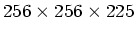 volume of 8-bit values. Because
the CT scan contains a lot of background (air), the dataset can be
significantly cropped without impinging on the cadaver head
itself14. We use the Hessian
second derivative measure to produce a
volume of 8-bit values. Because
the CT scan contains a lot of background (air), the dataset can be
significantly cropped without impinging on the cadaver head
itself14. We use the Hessian
second derivative measure to produce a  histogram volume which
includes first derivative values from zero to 66.0, and second
derivative values from -43.0 to 43.0.
histogram volume which
includes first derivative values from zero to 66.0, and second
derivative values from -43.0 to 43.0.
Figure 6.8 begins with a slice of the dataset and the two scatterplots. The two boundaries that are most evident from the scatterplots are those between air (around value 15) and soft tissue (value 90), and between soft tissue and bone (value 175). This is confirmed by looking at the plots of
 ,
,  , and
, and  in
Figures 6.8(d) through
6.8(f). The nearly ideal shape in the lower segment of
's graph (below value 90) indicates a clean boundary, while the
upper segment of 's graph (above value 90) is somewhat distorted.
in
Figures 6.8(d) through
6.8(f). The nearly ideal shape in the lower segment of
's graph (below value 90) indicates a clean boundary, while the
upper segment of 's graph (above value 90) is somewhat distorted.
Still, using a simple boundary emphasis function (Figure 6.8(g)) results in an opacity function with two main peaks which successfully display the air-skin and tissue-bone boundaries. The rendering in Figure 6.8(j) was produced with the opacity function in Figure 6.8(h). Besides seeing the surface of the skin, we also can discern the gauze over the forehead and under the chin that was used to immobilize the head during scanning. The spikes projecting from the mouth are an artifact in the dataset due to dental fillings scattering the X-rays. By removing the lower of the two peaks (Figure 6.8(i)), the surface of the skull becomes visible (Figure 6.8(k)). The third smaller peak did not correspond to any significant boundary.
As was mentioned in Section 4.3, generation of opacity functions is possible from histogram volumes smaller that the
sizes used elsewhere in this thesis.
Figure 6.9 shows the analysis of the CT head
using a  histogram volume. The plots of , , and
in Figures 6.9(a)
through 6.9(c) are similar to those for the
histogram volume (Figures 6.8(d)
through 6.8(f)), but they are noticeably smoother. As a
result, the generated opacity functions are also smoother, which is
sometimes a benefit if the rendering algorithm produces artifacts as a
result of sharp changes in the opacity function15. However, smoother
, , and functions are less accurate with respect to
the original dataset, and this can be a very significant problem. For
instance, the need for a higher
histogram volume. The plots of , , and
in Figures 6.9(a)
through 6.9(c) are similar to those for the
histogram volume (Figures 6.8(d)
through 6.8(f)), but they are noticeably smoother. As a
result, the generated opacity functions are also smoother, which is
sometimes a benefit if the rendering algorithm produces artifacts as a
result of sharp changes in the opacity function15. However, smoother
, , and functions are less accurate with respect to
the original dataset, and this can be a very significant problem. For
instance, the need for a higher
 setting
(Figure 6.9(a)) means that the new function
(Figure 6.8(f)) has a steeper slope, and thus the peaks
in the new opacity function (Figure 6.9(e)) are
narrower than before, even though we have used the exact same boundary
emphasis function (Figure 6.9(d)), and nothing has
changed about the underlying dataset. In spite of this, the new
opacity functions still lead to acceptable renderings of the air-skin
boundary (Figure 6.9(g)) and the tissue-bone
boundary (Figure 6.9(h)).
setting
(Figure 6.9(a)) means that the new function
(Figure 6.8(f)) has a steeper slope, and thus the peaks
in the new opacity function (Figure 6.9(e)) are
narrower than before, even though we have used the exact same boundary
emphasis function (Figure 6.9(d)), and nothing has
changed about the underlying dataset. In spite of this, the new
opacity functions still lead to acceptable renderings of the air-skin
boundary (Figure 6.9(g)) and the tissue-bone
boundary (Figure 6.9(h)).
Section 5.4 gave an overview of Levoy's two dimensional opacity functions and compared them to the ones presented in this thesis. We now compare the results of the two methods on the CT head dataset, as this is the only dataset we have renderings of using Levoy's technique. Levoy used the second of his two opacity functions, those designed for visualizing ``region boundary surfaces'' as described in Section 5.4.2. However, the exact settings he used for the opacity function (that is, the CT numbers he chose for each material), were not described, nor were any of the lighting or shading parameters for the rendering. The images which appeared in his paper, shown in Figure 6.10, will serve as the basis for the comparison.
 |
 calculation (from Equation 5.12), as well as
a new boundary emphasis function
calculation (from Equation 5.12), as well as
a new boundary emphasis function  . The new boundary emphasis
function has a narrower peak so that we can better differentiate the
regions in
. The new boundary emphasis
function has a narrower peak so that we can better differentiate the
regions in
 that correspond to the different boundaries.
The shown is based on a new histogram volume which includes
more of the range of gradient values than the one used in the previous
figures16.
that correspond to the different boundaries.
The shown is based on a new histogram volume which includes
more of the range of gradient values than the one used in the previous
figures16.
Just as inspection of graphs provided information about the
boundaries in a volume which could be displayed with one dimensional
opacity functions, the graphical representation of serves as
a visual summary of the boundaries which can be rendered using a two
dimensional opacity function. For instance, the long black streak
near the center of is the indication of the tissue-bone
boundary. Bone takes on a range of values in the CT scan because its
radio-opacity is not constant. The gradient magnitude at the midpoint
of the tissue-bone boundary varies in proportion with the bone value,
since the soft tissue radio-opacity is more constant. Thus the black
streak, marking the middle of the boundary, slants towards higher data
values as one moves upward along the gradient magnitude axis.
 |
A great deal can be learned about the structure of a dataset through
experimentation with the two dimensional opacity function
generated from the histogram volume. Figure 6.12
demonstrates this for the main structural components of the CT head by
showing opacity functions and the renderings which they produced.
Figure 6.12(a) shows the initial
as
calculated from Equation 5.13. No adjustments were
needed to produce the renderings. We can see the gauze strips
very clearly, but the sides of the head are obscured. By removing
some of the opaque regions (Figure 6.12(b)) from
at low data values and low gradient magnitudes, the gauze can
be completely removed from the rendering without disturbing the
air-skin boundary. The precise editing of
needed to
achieve this effect was guided by the image. In
Figure 6.12(c), the air-skin boundary is removed,
revealing the surface of the skull.
So far, we have shown that the semi-automatically generated two dimensional opacity functions succeed in capturing the boundaries in the dataset, and that minimal editing of the opacity function is needed to see the main boundaries. Thus, our method is at least as powerful as Levoy's, because we were able to visualize the same boundaries, but without needing to know the CT values for the materials beforehand. Furthermore, adjustments to the boundary emphasis function can be used for fine control of the rendered boundary appearance.
However, there is one last boundary in this dataset which was never visualized in Levoy's paper. Although disallowed by Levoy's own material adjacency restrictions (Section 5.4.2), there are boundaries between bone and air in the dataset. More precisely, in the skull's various sinus cavities, there are boundaries between bone and air which contain only a thin intermediate layer of mucus membrane. Because of the resolution of this particular CT scan, the measured boundaries of the sinus regions effectively span the data values for air and bone directly, thus the boundary can be selected with the right two dimensional opacity function. The tissue-bone boundary can be removed from the rendering with a simple change in the opacity function (Figure 6.13(a)), revealing the previously unseen bone-air boundary within the skull. Figure 6.13(b) shows the same boundary from another viewpoint, and a transparent layer of the air-skin boundary has re-introduced for reference. The shape of the frontal nasal cavity (above the eyes) is especially easy to discern. Also visible is are the mastoid air cells, a spongy region of the temporal bone in the skull, near the ears[Moo85].
 |
Because of where it lies in  space, the air-bone boundary can
not be visualized with any one dimensional opacity function, since the
soft tissue surrounding the skull would obscure it. Also, it can not
be visualized with Levoy's method for region boundary display, because
he is essentially using a one dimensional opacity function followed
with a scaling by the gradient magnitude (recall
Figure 5.12). The ability to see the air-bone
boundary is more an indication of the potential power of two
dimensional opacity functions in general, than it is a specific
demonstration of our method's effectiveness. The information captured
in the histogram volume, and made visible in , provided the
guidance in editing the
function needed to reveal the
boundary.
space, the air-bone boundary can
not be visualized with any one dimensional opacity function, since the
soft tissue surrounding the skull would obscure it. Also, it can not
be visualized with Levoy's method for region boundary display, because
he is essentially using a one dimensional opacity function followed
with a scaling by the gradient magnitude (recall
Figure 5.12). The ability to see the air-bone
boundary is more an indication of the potential power of two
dimensional opacity functions in general, than it is a specific
demonstration of our method's effectiveness. The information captured
in the histogram volume, and made visible in , provided the
guidance in editing the
function needed to reveal the
boundary.
and
includes first derivative values zero through 85.8. The
used for the calculation was zero.


